
CAT 2018Slot 1DILRQuestion & Solution
Data Set
Question 1
Based on the given information, which of the following statements MUST be FALSE?
In the teaching committee the number of educationalists is equal to the number of politicians
In the administration committee the number of bureaucrats is equal to the number of educationalists
The size of the research committee is less than the size of the teaching committee
The size of the research committee is less than the size of the administration committee
Solution:
Let us draw a table according to the information given.
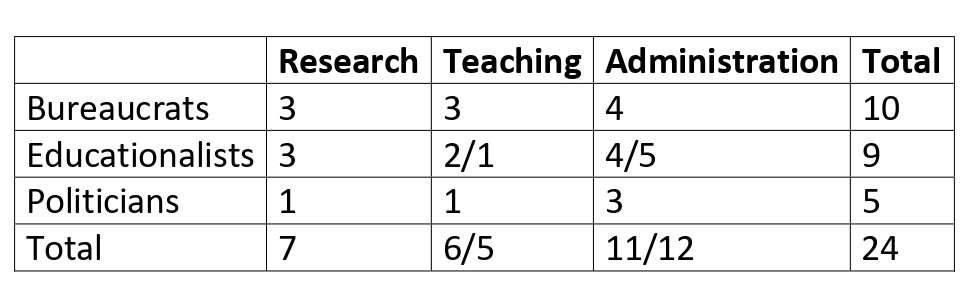
It is given that the numbers of bureaucrats in the research and teaching committees are equal, while the number of bureaucrats in the research committee is 75% of the number of bureaucrats in the administration committee. Let '4x' be the number of bureaucrats in Administration committee.
The number of educationalists in the teaching committee is less than the number of educationalists in the research committee. The number of educationalists in the research committee is the average of the numbers of educationalists in the other two committees. Let us assume that 'y' is the number of educationalists in the research committee and 'd' be the difference in the number of educationalists in Research and teaching committees.
60% of the politicians are in the administration committee, and 20% are in the teaching committee. Let '5z' be the number of total number of politicians.
We can say that
$\Rightarrow$ 10x+3y+5z = 24
We can see that each of x, y and z has to a natural number integer. If x > 1, then both y and z can't take any natural number.
Hence, we can say that x = 1.
At x = 1, 3y+5z = 14. If y = 1 or 2, Z is not an integer.
At x = 1 and y = 3, z = 1 which is the only possible solution.
We can see that 'd' can assume two possible values. d = 1 or 2.
Let us check the option one by one.
Option A: In the teaching committee the number of educationalists is equal to the number of politicians. We can see that in the teaching committee the number of educationalists can be equal to the number of politicians when both the numbers are '1'. Hence, this statement can be correct.
Option B: In the administration committee the number of bureaucrats is equal to the number of educationalists. We can see that in the administration committee the number of bureaucrats can be equal to the number of educationalists when both the numbers are '4'. Hence, this statement can be correct.
Option C: The size of the research committee is less than the size of the teaching committee. We can see the maximum size of teaching committee can be '6' which is less than the size of the research committee. Hence, the sentence is incorrect.
Option D: The size of the research committee is less than the size of the administration committee. We can see the minimum size of Administration committee can be '11' which is more than the size of the research committee. Hence, this statement is correct.
Therefore, we can say that option C is the correct answer.
Question 2
What is the number of bureaucrats in the administration committee?
Solution:
Let us draw a table according to the information given.
It is given that the numbers of bureaucrats in the research and teaching committees are equal, while the number of bureaucrats in the research committee is 75% of the number of bureaucrats in the administration committee. Let '4x' be the number of bureaucrats in Administration committee.
The number of educationalists in the teaching committee is less than the number of educationalists in the research committee. The number of educationalists in the research committee is the average of the numbers of educationalists in the other two committees. Let us assume that 'y' is the number of educationalists in the research committee and 'd' be the difference in the number of educationalists in Research and teaching committees.
60% of the politicians are in the administration committee, and 20% are in the teaching committee. Let '5z' be the number of total number of politicians.
We can say that
$\Rightarrow$ 10x+3y+5z = 24
We can see that each of x, y and z has to a natural number integer. If x > 1, then both y and z can't take any natural number.
Hence, we can say that x = 1.
At x = 1, 3y+5z = 14. If y = 1 or 2, Z is not an integer.
At x = 1 and y = 3, z = 1 which is the only possible solution.
We can see that 'd' can assume two possible values. d = 1 or 2.
From the table, we can see that the number of bureaucrats in the administration committee = 4.
Question 3
What is the number of educationalists in the research committee?
Solution:
Let us draw a table according to the information given.
It is given that the numbers of bureaucrats in the research and teaching committees are equal, while the number of bureaucrats in the research committee is 75% of the number of bureaucrats in the administration committee. Let '4x' be the number of bureaucrats in Administration committee.
The number of educationalists in the teaching committee is less than the number of educationalists in the research committee. The number of educationalists in the research committee is the average of the numbers of educationalists in the other two committees. Let us assume that 'y' is the number of educationalists in the research committee and 'd' be the difference in the number of educationalists in Research and teaching committees.
60% of the politicians are in the administration committee, and 20% are in the teaching committee. Let '5z' be the number of total number of politicians.
We can say that
$\Rightarrow$ 10x+3y+5z = 24
We can see that each of x, y and z has to a natural number integer. If x > 1, then both y and z can't take any natural number.
Hence, we can say that x = 1.
At x = 1, 3y+5z = 14. If y = 1 or 2, Z is not an integer.
At x = 1 and y = 3, z = 1 which is the only possible solution.
We can see that 'd' can assume two possible values. d = 1 or 2.
From the table, we can see that the number of educationalists in the research committee = 3.
Question 4
Which of the following CANNOT be determined uniquely based on the given information?
The size of the teaching committee
The size of the research committee
The total number of bureaucrats in the three committees
The total number of educationalists in the three committees
Solution:
Let us draw a table according to the information given.
It is given that the numbers of bureaucrats in the research and teaching committees are equal, while the number of bureaucrats in the research committee is 75% of the number of bureaucrats in the administration committee. Let '4x' be the number of bureaucrats in Administration committee.
The number of educationalists in the teaching committee is less than the number of educationalists in the research committee. The number of educationalists in the research committee is the average of the numbers of educationalists in the other two committees. Let us assume that 'y' is the number of educationalists in the research committee and 'd' be the difference in the number of educationalists in Research and teaching committees.
60% of the politicians are in the administration committee, and 20% are in the teaching committee. Let '5z' be the number of total number of politicians.
We can say that
$\Rightarrow$ 10x+3y+5z = 24
We can see that each of x, y and z has to a natural number integer. If x > 1, then both y and z can't take any natural number.
Hence, we can say that x = 1.
At x = 1, 3y+5z = 14. If y = 1 or 2, Z is not an integer.
At x = 1 and y = 3, z = 1 which is the only possible solution.
We can see that 'd' can assume two possible values. d = 1 or 2.
From the table, we can not uniquely determine the size of the teaching committee. Hence, option A is the correct answer.