
CAT 2019Slot 1DILRQuestion & Solution
Data Set
The figure below shows the street map for a certain region with the street intersections marked from a through l. A person standing at an intersection can see along straight lines to other intersections that are in her line of sight and all other people standing at these intersections. For example, a person standing at intersection g can see all people standing at intersections b, c, e, f, h, and k. In particular, the person standing at intersection g can see the person standing at intersection e irrespective of whether there is a person standing at intersection f.
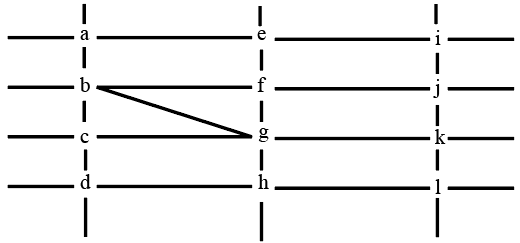
Six people U, V, W, X, Y, and Z, are standing at different intersections. No two people are standing at the same intersection.
The following additional facts are known.
1. X, U, and Z are standing at the three corners of a triangle formed by three street segments.
2. X can see only U and Z.
3. Y can see only U and W.
4. U sees V standing in the next intersection behind Z.
5. W cannot see V or Z.
6. No one among the six is standing at intersection d.
Question 1
Who is standing at intersection a?
W
Y
No one
V
Solution:
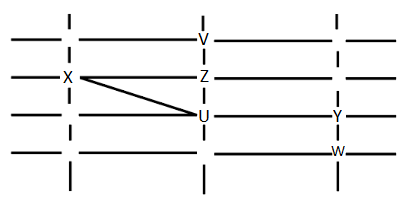
From 1, X, U, and Z are standing at the three corners of a triangle formed by three street segments.
From 2, X can see only U and Z.
From 4, U sees V standing in the next intersection behind Z. Also, no one among the six is standing at intersection d.
Only cases possible are:
1.
W cannot see V or Z. So W can only be at the intersection a. Since Y can see only U and W, Y can only be at c where X can see him. Hence this case is rejected.
2.
Y can only see U and W. Y cannot be placed anywhere. Hence this case is also rejected.
3.
Y can only see U and W. Y cannot be placed anywhere. Hence this case is also rejected.
4.
W cannot see V or Z. W can only be placed at i. Y can see only U and W. Y can only be placed at j or e, where he can see more people than U and W. Hence this case is also rejected.
5.
W cannot see V or Z. Y can only see U and W. Hence W and Y can only be placed as shown:
No one is standing at the intersection A. Hence C is the answer.
Question 2
Who can V see?
Z only
U, W and Z only
U and Z only
U only
Solution:
From 1, X, U, and Z are standing at the three corners of a triangle formed by three street segments.
From 2, X can see only U and Z.
From 4, U sees V standing in the next intersection behind Z. Also, no one among the six is standing at intersection d.
Only cases possible are:
1.
W cannot see V or Z. So W can only be at the intersection a. Since Y can see only U and W, Y can only be at c where X can see him. Hence this case is rejected.
2.
Y can only see U and W. Y cannot be placed anywhere. Hence this case is also rejected.
3.
Y can only see U and W. Y cannot be placed anywhere. Hence this case is also rejected.
4.
W cannot see V or Z. W can only be placed at i. Y can see only U and W. Y can only be placed at j or e, where he can see more people than U and W. Hence this case is also rejected.
5.
W cannot see V or Z. Y can only see U and W. Hence W and Y can only be placed as shown:
V can see U and Z only. Hence C is the answer.
Question 3
What is the minimum number of street segments that X must cross to reach Y?
1
4
2
3
Solution:
From 1, X, U, and Z are standing at the three corners of a triangle formed by three street segments.
From 2, X can see only U and Z.
From 4, U sees V standing in the next intersection behind Z. Also, no one among the six is standing at intersection d.
Only cases possible are:
1.
W cannot see V or Z. So W can only be at the intersection a. Since Y can see only U and W, Y can only be at c where X can see him. Hence this case is rejected.
2.
Y can only see U and W. Y cannot be placed anywhere. Hence this case is also rejected.
3.
Y can only see U and W. Y cannot be placed anywhere. Hence this case is also rejected.
4.
W cannot see V or Z. W can only be placed at i. Y can see only U and W. Y can only be placed at j or e, where he can see more people than U and W. Hence this case is also rejected.
5.
W cannot see V or Z. Y can only see U and W. Hence W and Y can only be placed as shown:
To reach Y, X has to go from b to g and g to k, i.e. 2 streets.
Question 4
Should a new person stand at intersection d, who among the six would she see?
W and X only
U and W only
U and Z only
V and X only
Solution:
From 1, X, U, and Z are standing at the three corners of a triangle formed by three street segments.
From 2, X can see only U and Z.
From 4, U sees V standing in the next intersection behind Z. Also, no one among the six is standing at intersection d.
Only cases possible are:
1.
W cannot see V or Z. So W can only be at the intersection a. Since Y can see only U and W, Y can only be at c where X can see him. Hence this case is rejected.
2.
Y can only see U and W. Y cannot be placed anywhere. Hence this case is also rejected.
3.
Y can only see U and W. Y cannot be placed anywhere. Hence this case is also rejected.
4.
W cannot see V or Z. W can only be placed at i. Y can see only U and W. Y can only be placed at j or e, where he can see more people than U and W. Hence this case is also rejected.
5.
W cannot see V or Z. Y can only see U and W. Hence W and Y can only be placed as shown:
If a new person stands at d(left down corner), they can see W and X only. Hence A is the answer.