
CAT 2020Slot 1DILRQuestion & Solution
Data Set
Question 1
In which of the following years were there two or more contracts?
2017
2016
2015
2018
Solution:
From IV: A, B, C, D have one 3, 7, 3, 4-year contract respectively and all other contracts are one-year contracts.
From
I, Z has at least one contract every year, the only possible
combination is 7+3 or 7+4 year contract and that 7-year contract must be
from B.
From III, Vendor W had contracts only in 2012 and
from VII, Institutes B and D each had exactly one contract in 2012
=> W has got contracts from A and C.
From II. Vendor X had one
or more contracts in every year up to 2015, but no contract in any year
after that and from VI, VII: C and D didn't have any contract in 2011
and 2010 respectively => A should have X as a 3-year contract from
2010-2012. Now, for 2013-2015 X can't have B for the same. So, X must
have got contracts from either C or D in that period.
Case 1:
X has C as a 3-year contract from 2013-2015 but in this case, D can't have any contract in 2012 so, this case is not valid.
Case 2:
X has D for a 4-year contract from 2012-2015 and C must have Z for a three-year contract in the period 2017-2019 such that Z has at least one contract every year.
It is known that over the decade, the
institutes each got into two contracts with two of these vendors, and
each vendor got into two contracts with two of these institutes => A
hasn't got any contract from 2013-2019 as it has X, W in the period
2010-2012 and similarly, C shouldn't have any contracts in the years 2010,
2013, 2014, 2015, 2016.
From III, Vendor Y had contracts in
2010 and 2019 and in 2010 D and C hasn't got any contract and A has
already got 2 different contracts from two different vendors => Y has
a contract from B in 2010 => B hasn't got any contracts in 2017,
2018, 2019.
For Y the only possible contract will be from D => D has got no contracts in the years 2011, 2016, 2017, 2018.
Now, the table looks like:
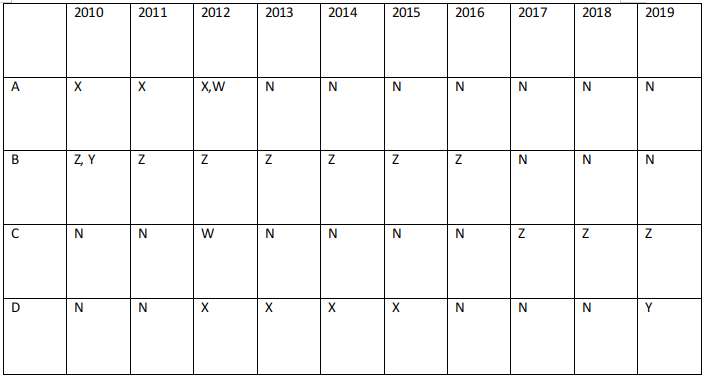
'N' represents no contract.
Out of the given options, only 2015 has two contracts and rest have only one contract in that particular year.
Question 2
Which of the following is true?
B had a contract with Z in 2017
B had a contract with Y in 2019
D had a contract with X in 2011
D had a contract with Y in 2019
Solution:
From IV: A, B, C, D have one 3, 7, 3, 4-year contract respectively and all other contracts are one-year contracts.
From
I, Z has at least one contract every year, the only possible
combination is 7+3 or 7+4 year contract and that 7-year contract must be
from B.
From III, Vendor W had contracts only in 2012 and
from VII, Institutes B and D each had exactly one contract in 2012
=> W has got contracts from A and C.
From II. Vendor X had one
or more contracts in every year up to 2015, but no contract in any year
after that and from VI, VII: C and D didn't have any contract in 2011
and 2010 respectively => A should have X as a 3-year contract from
2010-2012. Now, for 2013-2015 X can't have B for the same. So, X must
have got contracts from either C or D in that period.
Case 1:
X has C as a 3-year contract from 2013-2015 but in this case, D can't have any contract in 2012 so, this case is not valid.
Case 2:
X has D for a 4-year contract from 2012-2015 and C must have Z for a three-year contract in the period 2017-2019 such that Z has at least one contract every year.
It is known that over the decade, the
institutes each got into two contracts with two of these vendors, and
each vendor got into two contracts with two of these institutes => A
hasn't got any contract from 2013-2019 as it has X, W in the period
2010-2012 and similarly, C shouldn't have any contracts in the years 2010,
2013, 2014, 2015, 2016.
From III, Vendor Y had contracts in
2010 and 2019 and in 2010 D and C hasn't got any contract and A has
already got 2 different contracts from two different vendors => Y has
a contract from B in 2010 => B hasn't got any contracts in 2017,
2018, 2019.
For Y the only possible contract will be from D => D has got no contracts in the years 2011, 2016, 2017, 2018.
Now, the table looks like:
'N' represents no contract.
Option D is true.
Question 3
In how many years during this period was there only one contract?
3
2
4
5
Solution:
From IV: A, B, C, D have one 3, 7, 3, 4-year contract respectively and all other contracts are one-year contracts.
From
I, Z has at least one contract every year, the only possible
combination is 7+3 or 7+4 year contract and that 7-year contract must be
from B.
From III, Vendor W had contracts only in 2012 and
from VII, Institutes B and D each had exactly one contract in 2012
=> W has got contracts from A and C.
From II. Vendor X had one
or more contracts in every year up to 2015, but no contract in any year
after that and from VI, VII: C and D didn't have any contract in 2011
and 2010 respectively => A should have X as a 3-year contract from
2010-2012. Now, for 2013-2015 X can't have B for the same. So, X must
have got contracts from either C or D in that period.
Case 1:
X has C as a 3-year contract from 2013-2015 but in this case, D can't have any contract in 2012 so, this case is not valid.
Case 2:
X has D for a 4-year contract from 2012-2015 and C must have Z for a three-year contract in the period 2017-2019 such that Z has at least one contract every year.
It is known that over the decade, the
institutes each got into two contracts with two of these vendors, and
each vendor got into two contracts with two of these institutes => A
hasn't got any contract from 2013-2019 as it has X, W in the period
2010-2012 and similarly, C shouldn't have any contracts in the years 2010,
2013, 2014, 2015, 2016.
From III, Vendor Y had contracts in
2010 and 2019 and in 2010 D and C hasn't got any contract and A has
already got 2 different contracts from two different vendors => Y has
a contract from B in 2010 => B hasn't got any contracts in 2017,
2018, 2019.
For Y the only possible contract will be from D => D has got no contracts in the years 2011, 2016, 2017, 2018.
Now, the table looks like:
'N' represents no contract.
Only during 2016, 2017 and 2018, there was only one contract.
Question 4
What BEST can be concluded about the number of contracts in 2010?
exactly 4
exactly 3
at least 3
at least 4
Solution:
From IV: A, B, C, D have one 3, 7, 3, 4-year contract respectively and all other contracts are one-year contracts.
From
I, Z has at least one contract every year, the only possible
combination is 7+3 or 7+4 year contract and that 7-year contract must be
from B.
From III, Vendor W had contracts only in 2012 and
from VII, Institutes B and D each had exactly one contract in 2012
=> W has got contracts from A and C.
From II. Vendor X had one
or more contracts in every year up to 2015, but no contract in any year
after that and from VI, VII: C and D didn't have any contract in 2011
and 2010 respectively => A should have X as a 3-year contract from
2010-2012. Now, for 2013-2015 X can't have B for the same. So, X must
have got contracts from either C or D in that period.
Case 1:
X has C as a 3-year contract from 2013-2015 but in this case, D can't have any contract in 2012 so, this case is not valid.
Case 2:
X has D for a 4-year contract from 2012-2015 and C must have Z for a three-year contract in the period 2017-2019 such that Z has at least one contract every year.
It is known that over the decade, the
institutes each got into two contracts with two of these vendors, and
each vendor got into two contracts with two of these institutes => A
hasn't got any contract from 2013-2019 as it has X, W in the period
2010-2012 and similarly, C shouldn't have any contracts in the years 2010,
2013, 2014, 2015, 2016.
From III, Vendor Y had contracts in
2010 and 2019 and in 2010 D and C hasn't got any contract and A has
already got 2 different contracts from two different vendors => Y has
a contract from B in 2010 => B hasn't got any contracts in 2017,
2018, 2019.
For Y the only possible contract will be from D => D has got no contracts in the years 2011, 2016, 2017, 2018.
Now, the table looks like:
'N' represents no contract.
The Number of contracts in 2010 is three.
Question 5
Which institutes had multiple contracts during the same year?
A only
B and C only
A and B only
B only
Solution:
From IV: A, B, C, D have one 3, 7, 3, 4-year contract respectively and all other contracts are one-year contracts.
From
I, Z has at least one contract every year, the only possible
combination is 7+3 or 7+4 year contract and that 7-year contract must be
from B.
From III, Vendor W had contracts only in 2012 and
from VII, Institutes B and D each had exactly one contract in 2012
=> W has got contracts from A and C.
From II. Vendor X had one
or more contracts in every year up to 2015, but no contract in any year
after that and from VI, VII: C and D didn't have any contract in 2011
and 2010 respectively => A should have X as a 3-year contract from
2010-2012. Now, for 2013-2015 X can't have B for the same. So, X must
have got contracts from either C or D in that period.
Case 1:
X has C as a 3-year contract from 2013-2015 but in this case, D can't have any contract in 2012 so, this case is not valid.
Case 2:
X has D for a 4-year contract from 2012-2015 and C must have Z for a three-year contract in the period 2017-2019 such that Z has at least one contract every year.
It is known that over the decade, the
institutes each got into two contracts with two of these vendors, and
each vendor got into two contracts with two of these institutes => A
hasn't got any contract from 2013-2019 as it has X, W in the period
2010-2012 and similarly, C shouldn't have any contracts in the years 2010,
2013, 2014, 2015, 2016.
From III, Vendor Y had contracts in
2010 and 2019 and in 2010 D and C hasn't got any contract and A has
already got 2 different contracts from two different vendors => Y has
a contract from B in 2010 => B hasn't got any contracts in 2017,
2018, 2019.
For Y the only possible contract will be from D => D has got no contracts in the years 2011, 2016, 2017, 2018.
Now, the table looks like:
'N' represents no contract.
B and A have multiple contracts in a single year.
Question 6
Which institutes and vendors had more than one contracts in any year?
B, W, X, and Z
A, B, W, and X
A, D, W, and Z
B, D, W, and X
Solution:
From IV: A, B, C, D have one 3, 7, 3, 4-year contract respectively and all other contracts are one-year contracts.
From
I, Z has at least one contract every year, the only possible
combination is 7+3 or 7+4 year contract and that 7-year contract must be
from B.
From III, Vendor W had contracts only in 2012 and
from VII, Institutes B and D each had exactly one contract in 2012
=> W has got contracts from A and C.
From II. Vendor X had one
or more contracts in every year up to 2015, but no contract in any year
after that and from VI, VII: C and D didn't have any contract in 2011
and 2010 respectively => A should have X as a 3-year contract from
2010-2012. Now, for 2013-2015 X can't have B for the same. So, X must
have got contracts from either C or D in that period.
Case 1:
X has C as a 3-year contract from 2013-2015 but in this case, D can't have any contract in 2012 so, this case is not valid.
Case 2:
X has D for a 4-year contract from 2012-2015 and C must have Z for a three-year contract in the period 2017-2019 such that Z has at least one contract every year.
It is known that over the decade, the
institutes each got into two contracts with two of these vendors, and
each vendor got into two contracts with two of these institutes => A
hasn't got any contract from 2013-2019 as it has X, W in the period
2010-2012 and similarly, C shouldn't have any contracts in the years 2010,
2013, 2014, 2015, 2016.
From III, Vendor Y had contracts in
2010 and 2019 and in 2010 D and C hasn't got any contract and A has
already got 2 different contracts from two different vendors => Y has
a contract from B in 2010 => B hasn't got any contracts in 2017,
2018, 2019.
For Y the only possible contract will be from D => D has got no contracts in the years 2011, 2016, 2017, 2018.
Now, the table looks like:
'N' represents no contract.
A, B, W, X had more than one contracts in a single year