
CAT 2020Slot 2DILRQuestion & Solution
Data Set
In an election several candidates contested for a constituency. In any constituency, the winning candidate was the one who polled the highest number of votes, the first runner up was the one who polled the second highest number of votes, the second runner up was the one who polled the third highest number of votes, and so on. There were no ties (in terms of number of votes polled by the candidates) in any of the constituencies in this election. In an electoral system, a security deposit is the sum of money that a candidate is required to pay to the election commission before he or she is permitted to contest. Only the defeated candidates (i.e., one who is not the winning candidate) who fail to secure more than one sixth of the valid votes polled in the constituency, lose their security deposits.
The following table provides some incomplete information about votes polled in four constituencies: A, B, C and D, in this election .
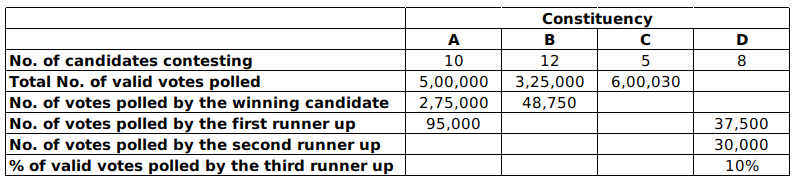
The following additional facts are known:
1. The first runner up polled 10,000 more votes than the second runner up in constituency A.
2. None of the candidates who contested in constituency C lost their security deposit. The difference in votes polled by any pair of candidates in this constituency was at least 10,000.
3. The winning candidate in constituency D polled 5% of valid votes more than that of the first runner up. All the candidates who lost their security deposits while contesting for this constituency, put together, polled 35% of the valid votes.
Question 1
What is the percentage of votes polled in total by all the candidates who lost their security deposits while contesting for constituency A?
Solution:
It's given in the question that the first runner up polled 10,000 more votes than the second runner up in constituency A. Now the first runner up has got 95000 votes, hence the second runner up will get 85000 votes.
Now the remaining votes will be 500000-275000-95000-85000=45000
From 2, None of the candidates who contested in constituency C lost their security deposit. The difference in votes polled by any pair of candidates in this constituency was at least 10,000 => the person who got 5th highest votes must have got > 600030/6 => $\ge$ 100006. Since it is also given that the difference of votes is $\ge$ 10000, the only possible case is winner, 1st runner up, 2nd runner up, 3rd runner up, 4th runner up must have got 140006,130006,120006,110006,100006 respectively which sums upto exactly 600030.
Let the number of votes polled in D be 100x.
From 3, The winning candidate in constituency D must have got 15x+37500
The table now looks like:
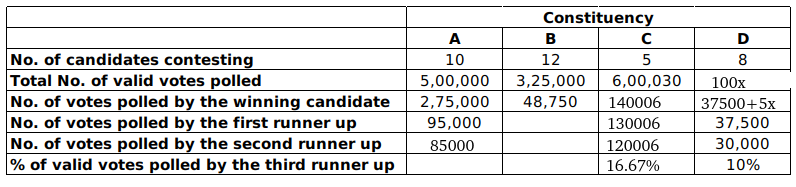
Total votes in A = 500000 => the candidates who got $\le$ 83333 must have lost their security deposits => candidates till 2nd runner up didn't lose their deposit =>all the candidates who received 500000-275000-95000-85000=45000 lost their deposits.
The percentage of votes polled in total by all the candidates who lost their security deposits while contesting for constituency A = 45000*100/500000 =9%
Question 2
How many candidates who contested in constituency B lost their security deposit?
Solution:
It's given in the question that the first runner up polled 10,000 more votes than the second runner up in constituency A. Now the first runner up has got 95000 votes, hence the second runner up will get 85000 votes.
Now the remaining votes will be 500000-275000-95000-85000=45000
From 2, None of the candidates who contested in constituency C lost their security deposit. The difference in votes polled by any pair of candidates in this constituency was at least 10,000 => the person who got 5th highest votes must have got > 600030/6 => $\ge$ 100006. Since it is also given that the difference of votes is $\ge$ 10000, the only possible case is winner, 1st runner up, 2nd runner up, 3rd runner up, 4th runner up must have got 140006,130006,120006,110006,100006 respectively which sums upto exactly 600030.
Let the number of votes polled in D be 100x.
From 3, The winning candidate in constituency D must have got 5x+37500
The table now looks like:
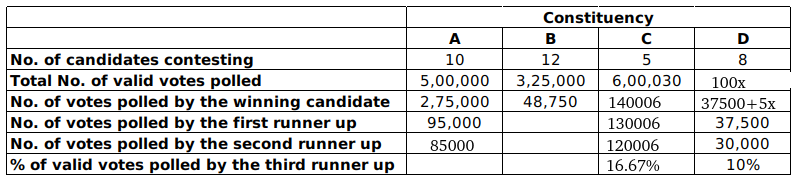
In constituency B, the mark for not losing the security deposit is 1/6(325000) or 54,167.
But winner himself/herself got < 54167 => all the other candidates lost their security deposits.
11 is the correct answer,
Question 3
What BEST can be concluded about the number of votes polled by the winning candidate in constituency C?
1,40,010
between 1,40,005 and 1,40,010
less than 2,00,010
1,40,006
Solution:
It's given in the question that the first runner up polled 10,000 more votes than the second runner up in constituency A. Now the first runner up has got 95000 votes, hence the second runner up will get 85000 votes.
Now the remaining votes will be 500000-275000-95000-85000=45000
From 2, None of the candidates who contested in constituency C lost their security deposit. The difference in votes polled by any pair of candidates in this constituency was at least 10,000 => the person who got 5th highest votes must have got > 600030/6 => $\ge$ 100006. Since it is also given that the difference of votes is $\ge$ 10000, the only possible case is winner, 1st runner up, 2nd runner up, 3rd runner up, 4th runner up must have got 140006,130006,120006,110006,100006 respectively which sums upto exactly 600030.
Let the number of votes polled in D be 100x.
From 3, The winning candidate in constituency D must have got 37500+5x.
The table now looks like:
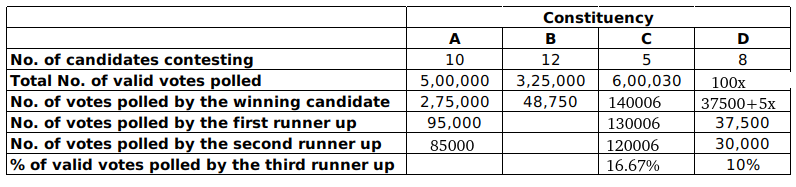
Number of votes polled to winning candidate must be 140006.
Question 4
What was the number of valid votes polled in constituency D?
1,25,000
1,50,000
1,75,000
62,500
Solution:
It's given in the question that the first runner up polled 10,000 more votes than the second runner up in constituency A. Now the first runner up has got 95000 votes, hence the second runner up will get 85000 votes.
Now the remaining votes will be 500000-275000-95000-85000=45000
From 2, None of the candidates who contested in constituency C lost their security deposit. The difference in votes polled by any pair of candidates in this constituency was at least 10,000 => the person who got 5th highest votes must have got > 600030/6 => $\ge$ 100006. Since it is also given that the difference of votes is $\ge$ 10000, the only possible case is winner, 1st runner up, 2nd runner up, 3rd runner up, 4th runner up must have got 140006,130006,120006,110006,100006 respectively which sums upto exactly 600030.
From 3, Let the total votes in D be 100x => The winning candidate in constituency D must have got 37500+5x.
The table now looks like:
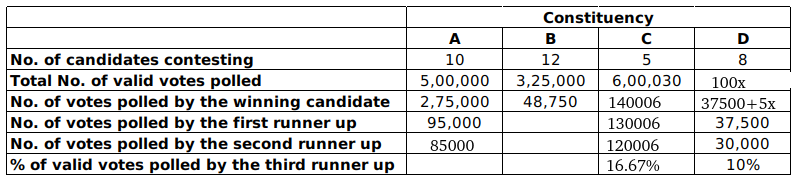
The candidates who didn't lose the deposit must have got <16.67% => 3rd runner up must surely didn't get the deposit.
Also, the candidates who got security deposit must have got 65% of votes.
Case I:
Let top three candidates got the security deposit => 37500+5x+37500+30000 =65x => x=1750 => 100x= 175000
Case II:
Let top three candidates got the security deposit => 37500+5x+37500 =65x => 60x = 1250 => x=125000 but 16.66% of 125000 =20834 => 2nd runner up must got security deposit. So, this case is not valid.
The increasing order C will always come after D which is not happening in the third option. Hence that is the correct answer.
Question 5
The winning margin of a constituency is defined as the difference of votes polled by the winner and that of the first runner up. Which of the following CANNOT be the list of constituencies, in increasing order of winning margin?
D, B, C, A
B, D, C, A
B, C, D, A
D, C, B, A
Solution:
It's given in the question that the first runner up polled 10,000 more votes than the second runner up in constituency A. Now the first runner up has got 95000 votes, hence the second runner up will get 85000 votes.
Now the remaining votes will be 500000-275000-95000-85000=45000
From 2, None of the candidates who contested in constituency C lost their security deposit. The difference in votes polled by any pair of candidates in this constituency was at least 10,000 => the person who got 5th highest votes must have got > 600030/6 => $\ge$ 100006. Since it is also given that the difference of votes is $\ge$ 10000, the only possible case is winner, 1st runner up, 2nd runner up, 3rd runner up, 4th runner up must have got 140006,130006,120006,110006,100006 respectively which sums upto exactly 600030.
From 3, The winning candidate in constituency D must have got 1.05*37500 = 39375.
Let the number of votes polled in D be 100x.
The table now looks like:
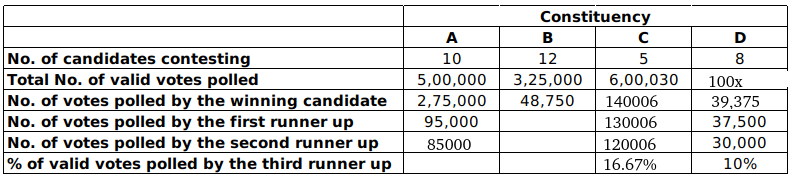
As calculated in the previous question, candidate D got 175000 votes. The winner got 5% more votes than first runner up, hence the winner got 0.05*175000 i.e 8750 more votes than first runner up . Thus 8750 is the winning margin for constituency D. Moreover margin in constituency is atleast 10000 . Hence in the increasing order C will always come after D which is not happening in the third option. Hence that is the correct answer.
Question 6
For all the four constituencies taken together, what was the approximate number of votes polled by all the candidates who lost their security deposit expressed as a percentage of the total valid votes from these four constituencies?
38.25%
23.54%
23.91%
32.00%
Solution:
It's given in the question that the first runner up polled 10,000 more votes than the second runner up in constituency A. Now the first runner up has got 95000 votes, hence the second runner up will get 85000 votes.
Now the remaining votes will be 500000-275000-95000-85000=45000
From 2, None of the candidates who contested in constituency C lost their security deposit. The difference in votes polled by any pair of candidates in this constituency was at least 10,000 => the person who got 5th highest votes must have got > 600030/6 => $\ge$ 100006. Since it is also given that the difference of votes is $\ge$ 10000, the only possible case is winner, 1st runner up, 2nd runner up, 3rd runner up, 4th runner up must have got 140006,130006,120006,110006,100006 respectively which sums upto exactly 600030.
From 3, Let the total votes in D be 100x => The winning candidate in constituency D must have got 37500+5x.
The table now looks like:
The candidates who didn't lose the deposit must have got <16.67% => 3rd runner up must surely didn't get the deposit.
Also, the candidates who got security deposit must have got 65% of votes.
Case I:
Let top three candidates got the security deposit => 37500+5x+37500+30000 =65x => x=1750 => 100x= 175000
Case II:
Let top three candidates got the security deposit => 37500+5x+37500
=65x => 60x = 1250 => x=125000 but 16.66% of 125000 =20834 =>
2nd runner up must got security deposit. So, this case is not valid.
For all the constituencies lets look at the candidates who lost their security deposit.
A (500000-275000-95000-85000)=45000.
B (325000-48750)=276250
C (0) and D (61250)=175000-46250-30000-37500
Hence percentage will be 382500/1600000× 100=23.91%