
CAT 2020Slot 3DILRQuestion & Solution
Data Set
Sixteen patients in a hospital must undergo a blood test for a disease. It is known that exactly one of them has the disease. The hospital has only eight testing kits and has decided to pool blood samples of patients into eight vials for the tests. The patients are numbered 1 through 16, and the vials are labelled A, B, C, D, E, F, G, and H. The following table shows the vials into which each patient’s blood sample is distributed.
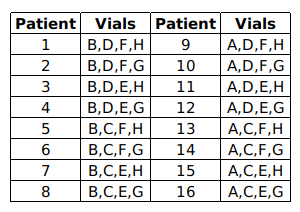
If a patient has the disease, then each vial containing his/her blood sample will test positive. If a vial tests positive, one of the patients whose blood samples were mixed in the vial has the disease. If a vial tests negative, then none of the patients whose blood samples were mixed in the vial has the disease.
Question 1
Suppose vial C tests positive and vials A, E and H test negative. Which patient has the disease?
Patient 14
Patient 8
Patient 6
Patient 2
Solution:
The patients in
Vial A: 9, 10, 11, 12, 13, 14, 15, 16
Vial B: 1, 2, 3, 4, 5, 6, 7, 8.
Vial C: 5,6,7,8,13,14,15,16
Vial D:1,2,3,4,9,10,11,12
Vial E:3,4,7,8,11,12,15,16
Vial F:1,2,5,6,9,10,13,14
Vial G:2,4,6,8,10,12,14,16
Vial H:1,3,5,7,9,11,13,15
If vial C tests positive and vials A, E and H test negative then Patient 6 must have disease as all other patients in Vial C expect patient 6 are present in at least one of A, E, H.
Question 2
Suppose vial A tests positive and vials D and G test negative. Which of the following vials should we test next to identify the patient with the disease?
Vial B
Vial E
Vial C
Vial H
Solution:
The patients in
Vial A: 9, 10, 11, 12, 13, 14, 15, 16
Vial B: 1, 2, 3, 4, 5, 6, 7, 8.
Vial C: 5,6,7,8,13,14,15,16
Vial D:1,2,3,4,9,10,11,12
Vial E:3,4,7,8,11,12,15,16
Vial F:1,2,5,6,9,10,13,14
Vial G:2,4,6,8,10,12,14,16
Vial H:1,3,5,7,9,11,13,15
Suppose vial A tests positive and vials D and G test negative then the patient who tested positive must be one of patient 13 or 15.
Patient 13 or 15 are not present in vial B. So, A is not the answer.
Both patients present in vial C. Even if tested positive or negative we can't know who has got the disease. So, C is not the answer.
Both patients present in vial H. Even if tested positive or negative we can't know who has got the disease. So, H is not the answer.
only patient 15 is present in vial E, if tested positive then patient 15 has the disease else patient 13 as disease.
Hence Option 2 is correct.
Question 3
Which of the following combinations of test results is NOT possible?
Vials A and E positive, vials C and D negative
Vial B positive, vials C, F and H negative
Vials A and G positive, vials D and E negative
Vials B and D positive, vials F and H negative
Solution:
The patients in
Vial A: 9, 10, 11, 12, 13, 14, 15, 16
Vial B: 1, 2, 3, 4, 5, 6, 7, 8.
Vial C: 5,6,7,8,13,14,15,16
Vial D:1,2,3,4,9,10,11,12
Vial E:3,4,7,8,11,12,15,16
Vial F:1,2,5,6,9,10,13,14
Vial G:2,4,6,8,10,12,14,16
Vial H:1,3,5,7,9,11,13,15
If vials C and D negative then no patient could test negative. Hence A is correct answer.
Question 4
Suppose one of the lab assistants accidentally mixed two patients' blood samples before they were distributed to the vials. Which of the following correctly represents the set of all possible numbers of positive test results out of the eight vials?
{5,6,7,8}
{4,5,6,7}
{4,5,6,7,8}
{4,5}
Solution:
Let one of the patients, patient 1 or patient 16 has the disease and his blood is mixed with other them all 8 vials will tests positive. ⇒
8 has to be one of the answers.
If patient 2 and patients 16’s blood is mixed of one of them has the disease then 7 of the 8 vials will test positive. So 7 has to be there in the option.
If 1 has the disease and 1, 7 are mixed then 6 out the 8 vials tests positive.
IF 1 has the disease and 1,9 are mixed then 5 of the 8 vials tests positive,
Now, let us assume that patient 1 has the disease if his blood is not mixed,
then 4 vials will definitely show positive.
Hence 3 is the correct answer.