
CAT 2020Slot 3DILRQuestion & Solution
Data Set
Question 1
What were the bids by Arun, Bankim, Charu and Dipak, respectively in the first round?
Hi, Lo, Lo, Hi
Hi, Lo, Lo, Lo
Hi, Hi, Lo, Lo
Lo, Lo, Lo, Hi
Solution:
Let 'H' represents Hi and 'L' represents Lo.
Given if they bid
Case 1: HHHH then all players gets -1 points.
Case 2: HHHL => H gets +1 and L gets -3.
Case 3: HHLL => H gets +2 and L gets -2.
Case 4: HLLL => H gets +3 and L gets -1.
Case 5: LLLL => every player gets +1.
From the given information we can draw the following table:
**T1 is the cumulative of points till Round 3 and T2 is sum of points till round 6.
**Arun, Bankim, Charu, and Dipak are represented by A, B, C, D respectively.
From point 3, D1>D2>D3
D scored 2 points till round R3 and D1>D3>D2 the possible scenarios are :
Case D1: 3,2,-3
In this case the points of A in R1, R3, R2 will be -1,2/-2, 1 in any possible combination the sum will not be 6. So, this case is invalid.
Case D2: 2,1,-1
In this case the points of A in R1, R3, R2 will be 2/-2, 1/-3, -1/3 so, if the points in R1, R3, R2 are 2,1,3 the case is valid and no other cases are possible.
Case D3: 3,1,-2
In this case the points of A in R1, R3, R2 will be -1, 1/-3/1, 2/-2
in any possible combination the sum will not be 6. So, this case is
invalid.
.'. Points of A,D in (R1,R2,R3) are (2,3,1) and (2,-1,1) respectively.
Since A got +3 in R2, he is only the one to bid h in R2 and points of B and C in round 2 are -1,-1 i.e they bid L, L.
Since A and D got 2 points each in R1, C and B must have got -2, -2 i.e they bid L, L.
Since A and D got 1 point in R3, C and B must also have got 1 in R3 i.e they bid L, L.
With this data, the table now looks like:
No information is given about the individual scores in R4, R5, R6.
Given In exactly two out of the six rounds, Arun was the only player who bid Hi.
Let R.x, R.y, R.z represent R4, R5, R6 in any order.
Let A bid H in R.x=> B,C,D bid L.
The table now looks like:
For A, R.x+R.y+R.z=1 => R.y+R.z=-2
For B, R.x+R.y+R.z=1 => R.y+R.z=2
For C, R.x+R.y+R.z=-3 => R.y+R.z=-2
For D, R.x+R.y+R.z=-3.=> R.y+R.z=-2
(R.y, R.z) for A can be (-3,1) or (-1,-1)
Case A1:
If for A, (R.y, R.z)=(-3,1)
Since for both C,D: R.y+R.z=-2
We can't get any combination such that the total points of B,C,D are obtained.
Case A2:
If for A, (R.y, R.z)=(-1,-1).the (R.y, R.z) of B,C,D can be (3,-1), (-1,-1), (-1,-1) and they must have bid (H,H), (L,H), (L,H) respectively while A must have bid (L, H)
Hence this case is valid.
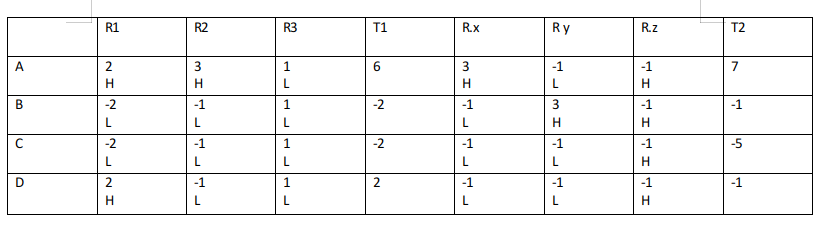
The final table looks like:
The bids by Arun, Bankim, Charu and Dipak, respectively in the first round are HLLH.
Hence Option A is correct.
Question 2
In how many rounds did Arun bid Hi?
Solution:
Let 'H' represents Hi and 'L' represents Lo.
Given if they bid
Case 1: HHHH then all players gets -1 points.
Case 2: HHHL => H gets +1 and L gets -3.
Case 3: HHLL => H gets +2 and L gets -2.
Case 4: HLLL => H gets +3 and L gets -1.
Case 5: LLLL => every player gets +1.
From the given information we can draw the following table:
**T1 is the cumulative of points till Round 3 and T2 is sum of points till round 6.
**Arun, Bankim, Charu, and Dipak are represented by A, B, C, D respectively.
From point 3, D1>D2>D3
D scored 2 points till round R3 and D1>D3>D2 the possible scenarios are :
Case D1: 3,2,-3
In this case the points of A in R1, R3, R2 will be -1,2/-2, 1 in any possible combination the sum will not be 6. So, this case is invalid.
Case D2: 2,1,-1
In this case the points of A in R1, R3, R2 will be 2/-2, 1/-3, -1/3 so, if the points in R1, R3, R2 are 2,1,3 the case is valid and no other cases are possible.
Case D3: 3,1,-2
In this case the points of A in R1, R3, R2 will be -1, 1/-3/1, 2/-2
in any possible combination the sum will not be 6. So, this case is
invalid.
.'. Points of A,D in (R1,R2,R3) are (2,3,1) and (2,-1,1) respectively.
Since A got +3 in R2, he is only the one to bid h in R2 and points of B and C in round 2 are -1,-1 i.e they bid L, L.
Since A and D got 2 points each in R1, C and B must have got -2, -2 i.e they bid L, L.
Since A and D got 1 point in R3, C and B must also have got 1 in R3 i.e they bid L, L.
With this data, the table now looks like:
No information is given about the individual scores in R4, R5, R6.
Given In exactly two out of the six rounds, Arun was the only player who bid Hi.
Let R.x, R.y, R.z represent R4, R5, R6 in any order.
Let A bid H in R.x=> B,C,D bid L.
The table now looks like:
For A, R.x+R.y+R.z=1 => R.y+R.z=-2
For B, R.x+R.y+R.z=1 => R.y+R.z=2
For C, R.x+R.y+R.z=-3 => R.y+R.z=-2
For D, R.x+R.y+R.z=-3.=> R.y+R.z=-2
(R.y, R.z) for A can be (-3,1) or (-1,-1)
Case A1:
If for A, (R.y, R.z)=(-3,1)
Since for both C,D: R.y+R.z=-2
We can't get any combination such that the total points of B,C,D are obtained.
Case A2:
If for A, (R.y, R.z)=(-1,-1).the (R.y, R.z) of B,C,D can be (3,-1), (-1,-1), (-1,-1) and they must have bid (H,H), (L,H), (L,H) respectively while A must have bid (L, H)
Hence this case is valid.
The final table looks like:
Arun bid high in R1,R2, R.x, R.z hence, 4 is correct answer.
Question 3
In how many rounds did Bankim bid Lo?
Solution:
Let 'H' represents Hi and 'L' represents Lo.
Given if they bid
Case 1: HHHH then all players gets -1 points.
Case 2: HHHL => H gets +1 and L gets -3.
Case 3: HHLL => H gets +2 and L gets -2.
Case 4: HLLL => H gets +3 and L gets -1.
Case 5: LLLL => every player gets +1.
From the given information we can draw the following table:
**T1 is the cumulative of points till Round 3 and T2 is sum of points till round 6.
**Arun, Bankim, Charu, and Dipak are represented by A, B, C, D respectively.
From point 3, D1>D2>D3
D scored 2 points till round R3 and D1>D3>D2 the possible scenarios are :
Case D1: 3,2,-3
In this case the points of A in R1, R3, R2 will be -1,2/-2, 1 in any possible combination the sum will not be 6. So, this case is invalid.
Case D2: 2,1,-1
In this case the points of A in R1, R3, R2 will be 2/-2, 1/-3, -1/3 so, if the points in R1, R3, R2 are 2,1,3 the case is valid and no other cases are possible.
Case D3: 3,1,-2
In this case the points of A in R1, R3, R2 will be -1, 1/-3/1, 2/-2
in any possible combination the sum will not be 6. So, this case is
invalid.
.'. Points of A,D in (R1,R2,R3) are (2,3,1) and (2,-1,1) respectively.
Since A got +3 in R2, he is only the one to bid h in R2 and points of B and C in round 2 are -1,-1 i.e they bid L, L.
Since A and D got 2 points each in R1, C and B must have got -2, -2 i.e they bid L, L.
Since A and D got 1 point in R3, C and B must also have got 1 in R3 i.e they bid L, L.
With this data, the table now looks like:
No information is given about the individual scores in R4, R5, R6.
Given In exactly two out of the six rounds, Arun was the only player who bid Hi.
Let R.x, R.y, R.z represent R4, R5, R6 in any order.
Let A bid H in R.x=> B,C,D bid L.
The table now looks like:
For A, R.x+R.y+R.z=1 => R.y+R.z=-2
For B, R.x+R.y+R.z=1 => R.y+R.z=2
For C, R.x+R.y+R.z=-3 => R.y+R.z=-2
For D, R.x+R.y+R.z=-3.=> R.y+R.z=-2
(R.y, R.z) for A can be (-3,1) or (-1,-1)
Case A1:
If for A, (R.y, R.z)=(-3,1)
Since for both C,D: R.y+R.z=-2
We can't get any combination such that the total points of B,C,D are obtained.
Case A2:
If for A, (R.y, R.z)=(-1,-1).the (R.y, R.z) of B,C,D can be (3,-1), (-1,-1), (-1,-1) and they must have bid (H,H), (L,H), (L,H) respectively while A must have bid (L, H)
Hence this case is valid.
The final table looks like:
Bikram bid Lo in R1,R2,R3,R.x. Hence 4 is correct answer.
Question 4
In how many rounds did all four players make identical bids?
Solution:
Let 'H' represents Hi and 'L' represents Lo.
Given if they bid
Case 1: HHHH then all players gets -1 points.
Case 2: HHHL => H gets +1 and L gets -3.
Case 3: HHLL => H gets +2 and L gets -2.
Case 4: HLLL => H gets +3 and L gets -1.
Case 5: LLLL => every player gets +1.
From the given information we can draw the following table:
**T1 is the cumulative of points till Round 3 and T2 is sum of points till round 6.
**Arun, Bankim, Charu, and Dipak are represented by A, B, C, D respectively.
From point 3, D1>D2>D3
D scored 2 points till round R3 and D1>D3>D2 the possible scenarios are :
Case D1: 3,2,-3
In this case the points of A in R1, R3, R2 will be -1,2/-2, 1 in any possible combination the sum will not be 6. So, this case is invalid.
Case D2: 2,1,-1
In this case the points of A in R1, R3, R2 will be 2/-2, 1/-3, -1/3 so, if the points in R1, R3, R2 are 2,1,3 the case is valid and no other cases are possible.
Case D3: 3,1,-2
In this case the points of A in R1, R3, R2 will be -1, 1/-3/1, 2/-2
in any possible combination the sum will not be 6. So, this case is
invalid.
.'. Points of A,D in (R1,R2,R3) are (2,3,1) and (2,-1,1) respectively.
Since A got +3 in R2, he is only the one to bid h in R2 and points of B and C in round 2 are -1,-1 i.e they bid L, L.
Since A and D got 2 points each in R1, C and B must have got -2, -2 i.e they bid L, L.
Since A and D got 1 point in R3, C and B must also have got 1 in R3 i.e they bid L, L.
With this data, the table now looks like:
No information is given about the individual scores in R4, R5, R6.
Given In exactly two out of the six rounds, Arun was the only player who bid Hi.
Let R.x, R.y, R.z represent R4, R5, R6 in any order.
Let A bid H in R.x=> B,C,D bid L.
The table now looks like:
For A, R.x+R.y+R.z=1 => R.y+R.z=-2
For B, R.x+R.y+R.z=1 => R.y+R.z=2
For C, R.x+R.y+R.z=-3 => R.y+R.z=-2
For D, R.x+R.y+R.z=-3.=> R.y+R.z=-2
(R.y, R.z) for A can be (-3,1) or (-1,-1)
Case A1:
If for A, (R.y, R.z)=(-3,1)
Since for both C,D: R.y+R.z=-2
We can't get any combination such that the total points of B,C,D are obtained.
Case A2:
If for A, (R.y, R.z)=(-1,-1).the (R.y, R.z) of B,C,D can be (3,-1), (-1,-1), (-1,-1) and they must have bid (H,H), (L,H), (L,H) respectively while A must have bid (L, H)
Hence this case is valid.
The final table looks like:
All the players made identical bids in R3 and R.z
Question 5
In how many rounds did Dipak gain exactly 1 point?
Solution:
Let 'H' represents Hi and 'L' represents Lo.
Given if they bid
Case 1: HHHH then all players gets -1 points.
Case 2: HHHL => H gets +1 and L gets -3.
Case 3: HHLL => H gets +2 and L gets -2.
Case 4: HLLL => H gets +3 and L gets -1.
Case 5: LLLL => every player gets +1.
From the given information we can draw the following table:
**T1 is the cumulative of points till Round 3 and T2 is sum of points till round 6.
**Arun, Bankim, Charu, and Dipak are represented by A, B, C, D respectively.
From point 3, D1>D2>D3
D scored 2 points till round R3 and D1>D3>D2 the possible scenarios are :
Case D1: 3,2,-3
In this case the points of A in R1, R3, R2 will be -1,2/-2, 1 in any possible combination the sum will not be 6. So, this case is invalid.
Case D2: 2,1,-1
In this case the points of A in R1, R3, R2 will be 2/-2, 1/-3, -1/3 so, if the points in R1, R3, R2 are 2,1,3 the case is valid and no other cases are possible.
Case D3: 3,1,-2
In this case the points of A in R1, R3, R2 will be -1, 1/-3/1, 2/-2
in any possible combination the sum will not be 6. So, this case is
invalid.
.'. Points of A,D in (R1,R2,R3) are (2,3,1) and (2,-1,1) respectively.
Since A got +3 in R2, he is only the one to bid h in R2 and points of B and C in round 2 are -1,-1 i.e they bid L, L.
Since A and D got 2 points each in R1, C and B must have got -2, -2 i.e they bid L, L.
Since A and D got 1 point in R3, C and B must also have got 1 in R3 i.e they bid L, L.
With this data, the table now looks like:
No information is given about the individual scores in R4, R5, R6.
Given In exactly two out of the six rounds, Arun was the only player who bid Hi.
Let R.x, R.y, R.z represent R4, R5, R6 in any order.
Let A bid H in R.x=> B,C,D bid L.
The table now looks like:
For A, R.x+R.y+R.z=1 => R.y+R.z=-2
For B, R.x+R.y+R.z=1 => R.y+R.z=2
For C, R.x+R.y+R.z=-3 => R.y+R.z=-2
For D, R.x+R.y+R.z=-3.=> R.y+R.z=-2
(R.y, R.z) for A can be (-3,1) or (-1,-1)
Case A1:
If for A, (R.y, R.z)=(-3,1)
Since for both C,D: R.y+R.z=-2
We can't get any combination such that the total points of B,C,D are obtained.
Case A2:
If for A, (R.y, R.z)=(-1,-1).the (R.y, R.z) of B,C,D can be (3,-1), (-1,-1), (-1,-1) and they must have bid (H,H), (L,H), (L,H) respectively while A must have bid (L, H)
Hence this case is valid.
The final table looks like:
Deepak got exactly one point in only R3.
Hence 1 is correct answer.
Question 6
In which of the following rounds, was Arun DEFINITELY the only player to bid Hi?
Second
Third
Fourth
First
Solution:
Let 'H' represents Hi and 'L' represents Lo.
Given if they bid
Case 1: HHHH then all players gets -1 points.
Case 2: HHHL => H gets +1 and L gets -3.
Case 3: HHLL => H gets +2 and L gets -2.
Case 4: HLLL => H gets +3 and L gets -1.
Case 5: LLLL => every player gets +1.
From the given information we can draw the following table:
**T1 is the cumulative of points till Round 3 and T2 is sum of points till round 6.
**Arun, Bankim, Charu, and Dipak are represented by A, B, C, D respectively.
From point 3, D1>D2>D3
D scored 2 points till round R3 and D1>D3>D2 the possible scenarios are :
Case D1: 3,2,-3
In this case the points of A in R1, R3, R2 will be -1,2/-2, 1 in any possible combination the sum will not be 6. So, this case is invalid.
Case D2: 2,1,-1
In this case the points of A in R1, R3, R2 will be 2/-2, 1/-3, -1/3 so, if the points in R1, R3, R2 are 2,1,3 the case is valid and no other cases are possible.
Case D3: 3,1,-2
In this case the points of A in R1, R3, R2 will be -1, 1/-3/1, 2/-2
in any possible combination the sum will not be 6. So, this case is
invalid.
.'. Points of A,D in (R1,R2,R3) are (2,3,1) and (2,-1,1) respectively.
Since A got +3 in R2, he is only the one to bid h in R2 and points of B and C in round 2 are -1,-1 i.e they bid L, L.
Since A and D got 2 points each in R1, C and B must have got -2, -2 i.e they bid L, L.
Since A and D got 1 point in R3, C and B must also have got 1 in R3 i.e they bid L, L.
With this data, the table now looks like:
No information is given about the individual scores in R4, R5, R6.
Given In exactly two out of the six rounds, Arun was the only player who bid Hi.
Let R.x, R.y, R.z represent R4, R5, R6 in any order.
Let A bid H in R.x=> B,C,D bid L.
The table now looks like:
For A, R.x+R.y+R.z=1 => R.y+R.z=-2
For B, R.x+R.y+R.z=1 => R.y+R.z=2
For C, R.x+R.y+R.z=-3 => R.y+R.z=-2
For D, R.x+R.y+R.z=-3.=> R.y+R.z=-2
(R.y, R.z) for A can be (-3,1) or (-1,-1)
Case A1:
If for A, (R.y, R.z)=(-3,1)
Since for both C,D: R.y+R.z=-2
We can't get any combination such that the total points of B,C,D are obtained.
Case A2:
If for A, (R.y, R.z)=(-1,-1).the (R.y, R.z) of B,C,D can be (3,-1), (-1,-1), (-1,-1) and they must have bid (H,H), (L,H), (L,H) respectively while A must have bid (L, H)
Hence this case is valid.
The final table looks like:
R2 is correct answer.