
CAT 2022Slot 1DILRQuestion & Solution
Data Set
Question 1
How many boys are there in the class?
Solution:
No. of girls = 15
Let the no. of boys be x
No. of singers = 6
No of boys who are singers = 4
Therefore, no of girls who are singers = 2
No of dancers = 10
No of boys who are dancers = 6
Therefore, no. of girls who are dancers = 4
No. of boys who are neither singers nor dancers = x-10
No. of girls who are neither singers nor dancers = 9
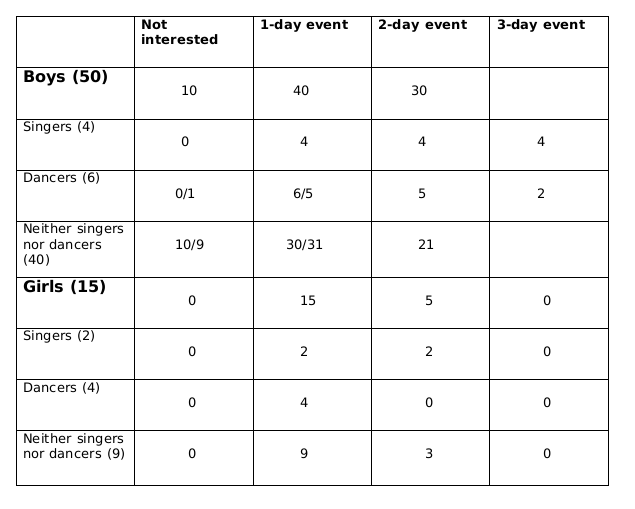
Now we fill the above table,
using statements 1 and 2, we get the following table
Let the number of girls who are interested in attending a 2-day event be a and the number of girls who are dancers and are interested in 2-day event be b.
Now using statements 3 and 4, we get
$2\le0.18x-4\le6$
$6\le0.18x\le10$
0.18x should be integer for which x should be a multiple of 50, and 0.18x lies between 6 and 10; therefore, the only possible value of x is 50.
From statement 5, we can say that,
4+ 0.4a - b = 5+b +1
or, 0.4a = 2+2b
or, a = 5(1+b)
a should be a multiple of 5 as b is a whole number. So possible values of a can be 5, 10 or 15. Now, as the maximum value of b can be 4 and the maximum value of 0.4a-b can be 2, so the only possible value of a satisfying the conditions above is 5. If a= 5 then b=1.
Question 2
Which of the following can be determined from the given information?
I. The number of boys who are interested in attending a 1-day event and are neither dancers nor singers.
II. The number of female dancers who are interested in attending a 1-day event.
Only I
Neither I nor II
Only II
Both I and II
Solution:
No. of girls = 15
Let the no. of boys be x
No. of singers = 6
No of boys who are singers = 4
Therefore, no of girls who are singers = 2
No of dancers = 10
No of boys who are dancers = 6
Therefore, no. of girls who are dancers = 4
No. of boys who are neither singers nor dancers = x-10
No. of girls who are neither singers nor dancers = 9
Now we fill the above table,
using statements 1 and 2, we get the following table
Let the number of girls who are interested in attending a 2-day event be a and the number of girls who are dancers and are interested in 2-day event be b.
Now using statements 3 and 4, we get
$2\le0.18x-4\le6$
$6\le0.18x\le10$
0.18x should be integer for which x should be a multiple of 50, and 0.18x lies between 6 and 10; therefore, the only possible value of x is 50.
From statement 5, we can say that,
4+ 0.4a - b = 5+b +1
or, 0.4a = 2+2b
or, a = 5(1+b)
a should be a multiple of 5 as b is a whole number. So possible values of a can be 5, 10 or 15. Now, as the maximum value of b can be 4 and the maximum value of 0.4a-b can be 2, so the only possible value of a satisfying the conditions above is 5. If a= 5 then b=1.
Question 3
What fraction of the class are interested in attending a 2-day event?
$\frac{7}{10}$
$\frac{7}{13}$
$\frac{9}{13}$
$\frac{2}{3}$
Solution:
No. of girls = 15
Let the no. of boys be x
No. of singers = 6
No of boys who are singers = 4
Therefore, no of girls who are singers = 2
No of dancers = 10
No of boys who are dancers = 6
Therefore, no. of girls who are dancers = 4
No. of boys who are neither singers nor dancers = x-10
No. of girls who are neither singers nor dancers = 9
Now we fill the above table,
using statements 1 and 2, we get the following table
Let the number of girls who are interested in attending a 2-day event be a and the number of girls who are dancers and are interested in 2-day event be b.
Now using statements 3 and 4, we get
$2\le0.18x-4\le6$
$6\le0.18x\le10$
0.18x should be integer for which x should be a multiple of 50, and 0.18x lies between 6 and 10; therefore, the only possible value of x is 50.
From statement 5, we can say that,
4+ 0.4a - b = 5+b +1
or, 0.4a = 2+2b
or, a = 5(1+b)
a should be a multiple of 5 as b is a whole number. So possible values of a can be 5, 10 or 15. Now, as the maximum value of b can be 4 and the maximum value of 0.4a-b can be 2, so the only possible value of a satisfying the conditions above is 5. If a= 5 then b=1.
Total students interested in 2-day event = 30+5 = 35
Total students = 15 + 50 = 65
Fraction = $\frac{35}{65}=\frac{7}{13}$
Question 4
What BEST can be concluded about the number of male dancers who are interested in attending a 1-day event?
5 or 6
6
5
4 or 6
Solution:
No. of girls = 15
Let the no. of boys be x
No. of singers = 6
No of boys who are singers = 4
Therefore, no of girls who are singers = 2
No of dancers = 10
No of boys who are dancers = 6
Therefore, no. of girls who are dancers = 4
No. of boys who are neither singers nor dancers = x-10
No. of girls who are neither singers nor dancers = 9
Now we fill the above table,
using statements 1 and 2, we get the following table
Let the number of girls who are interested in attending a 2-day event be a and the number of girls who are dancers and are interested in 2-day event be b.
Now using statements 3 and 4, we get
$2\le0.18x-4\le6$
$6\le0.18x\le10$
0.18x should be integer for which x should be a multiple of 50, and 0.18x lies between 6 and 10; therefore, the only possible value of x is 50.
From statement 5, we can say that,
4+ 0.4a - b = 5+b +1
or, 0.4a = 2+2b
or, a = 5(1+b)
a should be a multiple of 5 as b is a whole number. So possible values of a can be 5, 10 or 15. Now, as the maximum value of b can be 4 and the maximum value of 0.4a-b can be 2, so the only possible value of a satisfying the conditions above is 5. If a= 5 then b=1.
Question 5
How many female dancers are interested in attending a 2-day event?
2
1
0
Cannot be determined
Solution:
No. of girls = 15
Let the no. of boys be x
No. of singers = 6
No of boys who are singers = 4
Therefore, no of girls who are singers = 2
No of dancers = 10
No of boys who are dancers = 6
Therefore, no. of girls who are dancers = 4
No. of boys who are neither singers nor dancers = x-10
No. of girls who are neither singers nor dancers = 9
Now we fill the above table,
using statements 1 and 2, we get the following table
Let the number of girls who are interested in attending a 2-day event be a and the number of girls who are dancers and are interested in 2-day event be b.
Now using statements 3 and 4, we get
$2\le0.18x-4\le6$
$6\le0.18x\le10$
0.18x should be integer for which x should be a multiple of 50, and 0.18x lies between 6 and 10; therefore, the only possible value of x is 50.
From statement 5, we can say that,
4+ 0.4a - b = 5+b +1
or, 0.4a = 2+2b
or, a = 5(1+b)
a should be a multiple of 5 as b is a whole number. So possible values of a can be 5, 10 or 15. Now, as the maximum value of b can be 4 and the maximum value of 0.4a-b can be 2, so the only possible value of a satisfying the conditions above is 5. If a= 5 then b=1.