
CAT 2022Slot 1DILRQuestion & Solution
Data Set
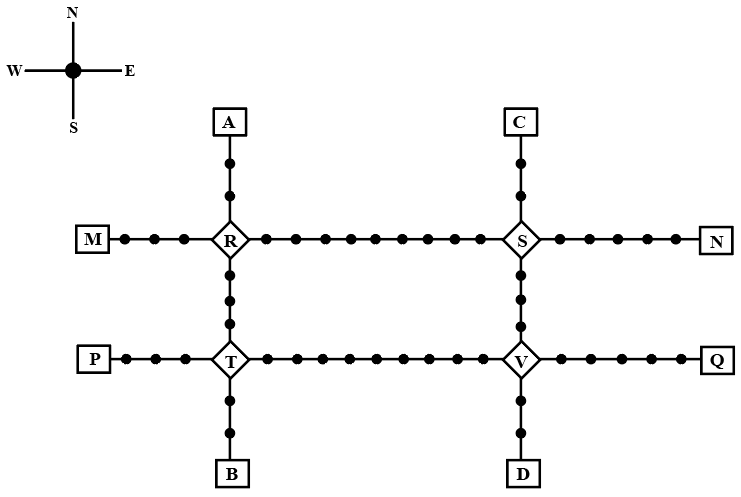
Given above is the schematic map of the metro lines in a city with rectangles denoting terminal stations (e.g. A), diamonds denoting junction stations (e.g. R) and small filled-up circles denoting other stations. Each train runs either in east-west or north-south direction, but not both. All trains stop for 2 minutes at each of the junction stations on the way and for 1 minute at each of the other stations. It takes 2 minutes to reach the next station for trains going in east-west direction and 3 minutes to reach the next station for trains going in northsouth direction. From each terminal station, the first train starts at 6 am; the last trains leave the terminal stations at midnight. Otherwise, during the service hours, there are metro service every 15 minutes in the north-south lines and every 10 minutes in the east-west lines. A train must rest for at least 15 minutes after completing a trip at the terminal station, before it can undertake the next trip in the reverse direction. (All questions are related to this metro service only. Assume that if someone reaches a station exactly at the time a train is supposed to leave, (s)he can catch that train.)
Question 1
If Hari is ready to board a train at 8:05 am from station M, then when is the earliest that he can reach station N?
9:11 am
9:06 am
9:01 am
9:13 am
Solution:
In the east-west direction, a train starts from station M every 10 minutes.
Now the first train leaving station M is at 6:00 am.
Since every 10 minutes trains are available in east-west direction, the train timings leaving from M will be like 6:10 am, 6:20 am, 6:30 am and so on.
Given, Hari has reached station M by 8:05 am.
So the earliest by which Hari can catch a train from station M is 8:10 am.
Now there are 19 stations between M and n, out of which two stations are junctions.
Time taken to travel between two stations in the east-west direction is 2 minutes.
Therefore, the time for which the train was running between M and N (excluding the stoppage time) = $20\times2=40$ minutes
Stoppage time at a junction is 2 minutes, while at the rest of the stations, it is 1 minute each.
Stoppage time for the train running between M and N = $\left(17\times1\right)+\left(2\times2\right)=\ 21$ minutes
Therefore, total travel time = 40+21 = 61 minutes.
So the time by which Hari reaches N is 8:10 am + 61 minutes = 9:11 am
Question 2
If Priya is ready to board a train at 10:25 am from station T, then when is the earliest that she can reach station S?
11:12 am
11:22 am
11:07 am
11:28 am
Solution:
Priya can reach S from T via R or V.
Case 1:- T-V-S
In the east-west direction, the first train from P arrives at T at time = 6 am + $(4 \times 2) + (3 \times 1) = 11$ minutes = 6:11 am
Since T is a junction so this train will halt for 2 minutes at T and leave at 6:13.
Priya boards a east-west train then Priya will board a train for V from T at 10:33 am.
There are 9 stations between T and V
Travelling time between T and V = $(10 \times 2) + (9 \times 1) = 29$ minutes
Therefore, Priya will reach V latest by 10:33 am + 29 minutes = 11:02 am
In the north-south direction, the first train from D arrives at V at time = 6 am + $(3 \times 3) + (2 \times 1) = 11$ minutes = 6:11 am
Since V is a junction so this train will halt for 2 minutes at V and leave at 6:13.
Since every 15 minutes, a train starts from D in the north-south direction, so the latest by which Priya will be able to board such a train from V is at 11:13 am.
There are 3 stations between V and S
Travelling time between R and S = $(4 \times 3) + (3 \times 1) = 15$ minutes
Time by which she reaches S = 11:13 +15 minutes = 11:28 am
Case 2:- T-R-S
In the north-south direction, the first train from B arrives at T at time = 6 am + $(3 \times 3) + (2 \times 1) = 11$ minutes = 6:11 am
Since T is a junction so this train will halt for 2 minutes at T and leave at 6:13.
Since every 15 minutes a train starts from P in the east-west direction so the latest by which Priya will be able to board such a train is at 10:28 am.
Now since she will be able to board a north-south train earlier than the east-west train so Priya will board a train for R from T at 10:28 am.
There are 3 stations between T and R
Travelling time between T and R = $(4 \times 3) + (3 \times 1) = 15$ minutes
Therefore, Priya will reach R latest by 10:43 am
In the east-west direction, the first train from M arrives at R at time = 6 am + $(4 \times 2) + (3 \times 1) = 11$ minutes = 6:11 am
Since R is a junction so this train will halt for 2 minutes at R and leave at 6:13.
Since every 10 minutes, a train starts from M in the east-west direction, so the latest by which Priya will be able to board such a train is at 10:43 am.
There are 9 stations between R and S
Travelling time between R and S = $(10 \times 2) + (9 \times 1) = 29$ minutes
Time by which she reaches S = 10:43 +29 minutes = 11:12 am
We are getting shorter time in case 2. So 11:12 am is the answer
Question 3
Haripriya is expected to reach station S late. What is the latest time by which she must be ready to board at station S if she must reach station B before 1 am via station R?
11:39 pm
11:49 am
11:35 pm
11:43 pm
Solution:
Travelling time between S and R = $(10 \times 2) + (9 \times 1) = 29$ minutes
There is a stoppage of 2 minutes at R
Travelling time between R and B = $(7 \times 3) + (1 \times 2) + (5 \times 1) = 28$ minutes
In the north-south direction, the first train from A arrives at R at time = 6 am + $(3 \times 3) + (2 \times 1) = 6:11$ am.
Since R is a junction so this train will halt for 2 minutes at R and leave at 6:13.
Every 15 minutes, a train starts from A in the north-south direction.
The last train that leaves A will be at 12:00 am and it will leave R at 12:13 am, so Haripriya must reach R till 12:13 am.
Travelling time between S and R = $(10 \times 2) + (9 \times 1) = 29$ minutes
So Haripriya must board the train at S by 11:44 pm
In the east-west direction, the first train from N arrives at S at time = 6 am + $(6 \times 2) + (5 \times 1) = 6:17$ am.
Since S is a junction so this train will halt for 2 minutes at S and leave at 6:19.
Every 10 minutes, a train starts from N in the east-west direction.
Therefore, Haripriya should board the train which leaves S at 11:39.
Question 4
What is the minimum number of trains that are required to provide the service on the AB line (considering both north and south directions)?
Solution:
Travel time between A and B = $\left(10\times3\right)+\left(7\times1\right)+\left(2\times2\right)=41$ minutes
After completing a journey, a train must rest for 15 minutes at least before starting again.
So if a train starts from 6 am from A to B, then the latest by which that train will start from B to A will be at 7 am, as in the north-south direction, a train starts from A and B every 15 minutes.
So the total no. of trains required = $\left(\frac{60}{15}\right)\times2=8$
Question 5
What is the minimum number of trains that are required to provide the service in this city?
Solution:
Travel time between A and B = $\left(10\times3\right)+\left(7\times1\right)+\left(2\times2\right)=41$ minutes
After completing a journey, a train must rest for 15 minutes at least before starting again.
So if a train starts from 6 am from A to B, then the latest by which that train will start from B to A will be at 7 am, as in the north-south direction, a train starts from A and B every 15 minutes.
So the total no. of trains required for the north-south lines =$\left(\frac{60}{15}\right)\times2\times2=16$
Travel time between M and N = $\left(20\times2\right)+\left(17\times1\right)+\left(2\times2\right)=61$ minutes
After completing a journey, a train must rest for 15 minutes at least before starting again.
So if a train starts from 6 am from M to N, then the latest by which that train will start from N to M will be at 7:20 am, as in the east-west direction, a train starts from M and N every 15 minutes.
So the total no. of trains required for the east-west lines= $\left(\frac{80}{10}\right)\times2\times2=32$
Total no. of trains required to service the city = 16+32 = 48