
CAT 2022Slot 2DILRQuestion & Solution
Data Set
Every day a widget supplier supplies widgets from the warehouse (W) to four locations - Ahmednagar (A), Bikrampore (B), Chitrachak (C), and Deccan Park (D). The daily demand for widgets in each location is uncertain and independent of each other. Demands and corresponding probability values (in parenthesis) are given against each location (A, B, C, and D) in the figure below. For example, there is a 40% chance that the demand in Ahmednagar will be 50 units and a 60% chance that the demand will be 70 units. The lines in the figure connecting the locations and warehouse represent two-way roads connecting those places with the distances (in km) shown beside the line. The distances in both the directions along a road are equal. For example, the road from Ahmednagar to Bikrampore and the road from Bikrampore to Ahmednagar are both 6 km long.
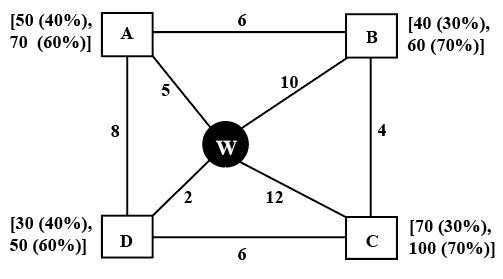
Every day the supplier gets the information about the demand values of the four locations and creates the travel route that starts from the warehouse and ends at a location after visiting all the locations exactly once. While making the route plan, the supplier goes to the locations in decreasing order of demand. If there is a tie for the choice of the next location, the supplier will go to the location closest to the current location. Also, while creating the route, the supplier can either follow the direct path (if available) from one location to another or can take the path via the warehouse. If both paths are available (direct and via warehouse), the supplier will choose the path with minimum distance.
Question 1
If the last location visited is Ahmednagar, then what is the total distance covered in the route (in km)?
Solution:
Points to be noted:
1. Starts from the warehouse and ends at a location after visiting all the locations exactly once.
2. While making the route plan, the supplier goes to the locations in decreasing order of demand. If equal demand, goes to the nearest ones first.
3. While creating the route, the supplier can either follow the direct path (if available) from one location to another or can take the path via the warehouse(Prefers minimum distance).
In the question, it is given that last location is A. The demand in the remaining places should be greater than A. This implies A demand cannot be 70 units. Therefore, it is 50 units.
The demand of the location D is 30 or 50 units. This implies this should be placed before D.
The demand of the location placed before D should be greater than or equal to 50 units. Location supplier visited before D is B(60 units of demand). It cannot be C because values of C is greater than the values of B.
Therefore, order is C - B - D - A.
From warehouse to C - 12 km
C to B - 4 km
B to D - 12 km
D to A - 7 km (through warehouse)
Total distance covered = 12 + 4 + 12 + 7 = 35 km
This question is removed from the paper because if the order is CBDA, the supplier will go to A from B (and hence the last city visited will be D).
Question 2
If the total number of widgets delivered in a day is 250 units, then what is the total distance covered in the route (in km)?
Solution:
Points to be noted:
1. Starts from the warehouse and ends at a location after visiting all the locations exactly once.
2. While making the route plan, the supplier goes to the locations in decreasing order of demand. If equal demand, goes to the nearest ones first.
3. While creating the route, the supplier can either follow the direct path (if available) from one location to another or can take the path via the warehouse(supplier prefers minimum distance).
In the question, it is given that total number of units delivered is 250 units.
Maximum number of widgets that can be delivered is 70 units(A) + 50 units(D) + 60 units(B) + 100 units(C) = 280 units
From this 30 units should be decreased. 30 units can be decreased only when C's demand decreases to 70 units(because the difference for remaining locations is 20 units)
Therefore, the only possibility is 70 units(A) + 50 units(D) + 60 units(B) + 70 units(C)
From statement 1, the order should be A - C - B - D(as A is nearer to warehouse than C)
Distance from Warehouse to A is 5 km
Distance from A to C is 17 km
Distance from C to B is 4 km
Distance from B to D is 12 km
Total distance covered = 5 + 17 + 4 + 12 = 38 km
Question 3
What is the chance that the total number of widgets delivered in a day is 260 units and the route ends at Bikrampore?
33.33%
10.80%
17.64%
7.56%
Solution:
Maximum number of widgets delivered in a day is 100 units(C) + 70 units(A) + 60 units(B) + 50 units(D), i.e. 280 units
Given, total number of widgets delivered is 260 units. This implies 20 units must be decreased from any one of the locations.
A - (70,50), B - (60,40), C - (100,70) and D - (50,30)
20 units can be decreased from A, B or D.
Demand at location C will be 100 units and supplier first visits C.
In the question, it is also given that the route ends at B.
C(100 units), _, _, B
If B's demand is 60 units, D's demand should be more than 60 units which is not possible. Therefore, B's demand should be 40 units.
20 units is decreased at location B. This implies demand at location A is 70 units and at location D is 50 units.
Order will be C(100 units) - A(70 units) - D(50 units) - B(40 units).
It is given,
C - 100 units - 70%
A - 70 units - 60%
D - 50 units - 60%
B - 40 units - 30%
Required value = 0.7*0.6*0.6*0.3 = 0.0756 = 7.56%
The answer is option D.
Question 4
If the first location visited from the warehouse is Ahmednagar, then what is the chance that the total distance covered in the route is 40 km?
18%
5.4%
3.24%
30%
Solution:
It is given that the first location visited from the warehouse is A.
If A's demand is 50 units, C's demand should be less than 50 units which is not possible. This implies demand of locations A and C is 70 units.
A(70 units) -> C(70 units)
Warehouse to A - 5km
A to C - 17 km
Distance covered = 5 + 17 = 22 km
Remaining distance = 40 - 22 = 18 km
C to B - 4 km
B to D - 12 km
Distance covered = 4 + 12 = 16 km $ e\$ 18 km
C to D - 6 km
D to B - 12 km
Distance covered = 6 + 12 = 18 km
Therefore, supplier can cover distance 18 km if he visits D before B, i.e. demand of D should be more than demand of B. This is only possible when D's demand is 50 units and B's demand is 40 units.
It is given,
D - 50 units - 60% probability
B - 40 units - 30% probability
Required value = 0.6*0.3 = 0.18 = 18%
The answer is option A.
Question 5
If Ahmednagar is not the first location to be visited in a route and the total route distance is 29 km, then which of the following is a possible number of widgets delivered on that day?
210
220
200
250
Solution:
Points to be noted:
1. Starts from the warehouse and ends at a location after visiting all the locations exactly once.
2. While making the route plan, the supplier goes to the locations in decreasing order of demand. If equal demand, goes to the nearest ones first.
3. While creating the route, the supplier can either follow the direct path (if available) from one location to another or can take the path via the warehouse(Prefers minimum distance).
Demand in all other locations should be less than or equal to the demand in first location. In the question, it is given that A is not first location. B and D cannot be first location. This implies C should be the first location.
It is given, total route distance is 29 km.
Warehouse to C is 12 km.
This implies remaining distance should be 29-12, i.e. 17km
This is only possible when C visits B, A and D later(4 + 6 + 7).
The order should be C - B - A - D
C's demand can be 70/100, B's demand should be 60, A's demand should be 50 and D's demand can be 30/50.
The possible number of widgets delivered can be
70 + 60 + 50 + 30 = 210
70 + 60 + 50 + 50 = 230
100 + 60 + 50 + 30 = 240
100 + 60 + 50 + 50 = 260
The answer is option A.