
CAT 2022Slot 2DILRQuestion & Solution
Data Set
Question 1
What was the total number of households met by Tohri, Hokli and Lahur on the first day?
Solution:
In statement 1, it is given that all three of them met the same total number of households, and each of them sold a total of 100 items in two days. In statement 2, it is given that on both days, Lahur met the same number of households and sold the same number of items. This implies he sold 50 items per day. Let the number households Lahur met in a day be 'x'.
Total number of households each of them met in two days will be '2x'.
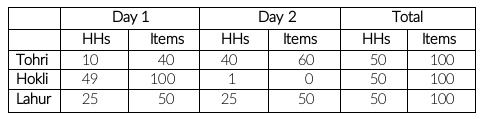
In statement 3, it is given that Hokli could not sell any item on the second day because the first household he met on that day complained against him. This implies he met only 1 household on day 2.
In statement 4, it is given that Tohri met 30 more households on the second day than on the first day.
Let the number of households Tohri met on day 1 be 'a'
It is given,
a + a + 30 = 2x
a + 15 = x
a = x - 15
In statement 5, it is given that
$2\left(\frac{50}{x}\right)=\frac{y}{x-15}$ ...... (1)
$\frac{3}{4}\left(\frac{50}{x}\right)=\ \frac{\ 100-y}{x+15}$ ...... (2)
$\frac{100}{x}=\ \frac{\ y}{x-15}$
$\frac{100}{y}=\ \frac{\ x}{x-15}$
$\frac{y}{100}=\ \ 1-\frac{15}{x}$
$x=\frac{1500}{100-y}$
Substituting x in (2), we get
y = 40 and x = 25
Final Table:
The total number of households met by Tohri, Hokli and Lahur on the first day is 10 + 49 + 25, i.e. 84.
Question 2
How many TRICCEK items were sold by Tohri on the first day?
Solution:
In statement 1, it is given that all three of them met the same total number of households, and each of them sold a total of 100 items in two days. In statement 2, it is given that on both days, Lahur met the same number of households and sold the same number of items. This implies he sold 50 items per day. Let the number households Lahur met in a day be 'x'.
Total number of households each of them met in two days will be '2x'.
In statement 3, it is given that Hokli could not sell any item on the second day because the first household he met on that day complained against him. This implies he met only 1 household on day 2.
In statement 4, it is given that Tohri met 30 more households on the second day than on the first day.
Let the number of households Tohri met on day 1 be 'a'
It is given,
a + a + 30 = 2x
a + 15 = x
a = x - 15
In statement 5, it is given that
$2\left(\frac{50}{x}\right)=\frac{y}{x-15}$ ...... (1)
$\frac{3}{4}\left(\frac{50}{x}\right)=\ \frac{\ 100-y}{x+15}$ ...... (2)
$\frac{100}{x}=\ \frac{\ y}{x-15}$
$\frac{100}{y}=\ \frac{\ x}{x-15}$
$\frac{y}{100}=\ \ 1-\frac{15}{x}$
$x=\frac{1500}{100-y}$
Substituting x in (2), we get
y = 40 and x = 25
Final Table:
The number of items sold by Tohri on the first day is 40.
Question 3
How many households did Lahur meet on the second day?
between 21 and 29
20 or less
more than 35
between 30 and 35
Solution:
In statement 1, it is given that all three of them met the same total number of households, and each of them sold a total of 100 items in two days. In statement 2, it is given that on both days, Lahur met the same number of households and sold the same number of items. This implies he sold 50 items per day. Let the number households Lahur met in a day be 'x'.
Total number of households each of them met in two days will be '2x'.
In statement 3, it is given that Hokli could not sell any item on the second day because the first household he met on that day complained against him. This implies he met only 1 household on day 2.
In statement 4, it is given that Tohri met 30 more households on the second day than on the first day.
Let the number of households Tohri met on day 1 be 'a'
It is given,
a + a + 30 = 2x
a + 15 = x
a = x - 15
In statement 5, it is given that
$2\left(\frac{50}{x}\right)=\frac{y}{x-15}$ ...... (1)
$\frac{3}{4}\left(\frac{50}{x}\right)=\ \frac{\ 100-y}{x+15}$ ...... (2)
$\frac{100}{x}=\ \frac{\ y}{x-15}$
$\frac{100}{y}=\ \frac{\ x}{x-15}$
$\frac{y}{100}=\ \ 1-\frac{15}{x}$
$x=\frac{1500}{100-y}$
Substituting x in (2), we get
y = 40 and x = 25
Final Table:
Lahur met 25 households on day 2. The answer is option A.
Question 4
How many households did Tohri meet on the first day?
between 21 and 40
between 11 and 20
more than 40
10 or less
Solution:
In statement 1, it is given that all three of them met the same total number of households, and each of them sold a total of 100 items in two days. In statement 2, it is given that on both days, Lahur met the same number of households and sold the same number of items. This implies he sold 50 items per day. Let the number households Lahur met in a day be 'x'.
Total number of households each of them met in two days will be '2x'.
In statement 3, it is given that Hokli could not sell any item on the second day because the first household he met on that day complained against him. This implies he met only 1 household on day 2.
In statement 4, it is given that Tohri met 30 more households on the second day than on the first day.
Let the number of households Tohri met on day 1 be 'a'
It is given,
a + a + 30 = 2x
a + 15 = x
a = x - 15
In statement 5, it is given that
$2\left(\frac{50}{x}\right)=\frac{y}{x-15}$ ...... (1)
$\frac{3}{4}\left(\frac{50}{x}\right)=\ \frac{\ 100-y}{x+15}$ ...... (2)
$\frac{100}{x}=\ \frac{\ y}{x-15}$
$\frac{100}{y}=\ \frac{\ x}{x-15}$
$\frac{y}{100}=\ \ 1-\frac{15}{x}$
$x=\frac{1500}{100-y}$
Substituting x in (2), we get
y = 40 and x = 25
Final Table:
Tohri met 10 households on day 1. The answer is option D.
Question 5
Which of the following statements is FALSE?
Among the three, Tohri had the highest success rate on the second day.
Tohri had a higher success rate on the first day compared to the second day.
Among the three, Tohri had the highest success rate on the first day.
Among the three, Lahur had the lowest success rate on the first day.
Solution:
In statement 1, it is given that all three of them met the same total number of households, and each of them sold a total of 100 items in two days. In statement 2, it is given that on both days, Lahur met the same number of households and sold the same number of items. This implies he sold 50 items per day. Let the number households Lahur met in a day be 'x'.
Total number of households each of them met in two days will be '2x'.
In statement 3, it is given that Hokli could not sell any item on the second day because the first household he met on that day complained against him. This implies he met only 1 household on day 2.
In statement 4, it is given that Tohri met 30 more households on the second day than on the first day.
Let the number of households Tohri met on day 1 be 'a'
It is given,
a + a + 30 = 2x
a + 15 = x
a = x - 15
In statement 5, it is given that
$2\left(\frac{50}{x}\right)=\frac{y}{x-15}$ ...... (1)
$\frac{3}{4}\left(\frac{50}{x}\right)=\ \frac{\ 100-y}{x+15}$ ...... (2)
$\frac{100}{x}=\ \frac{\ y}{x-15}$
$\frac{100}{y}=\ \frac{\ x}{x-15}$
$\frac{y}{100}=\ \ 1-\frac{15}{x}$
$x=\frac{1500}{100-y}$
Substituting x in (2), we get
y = 40 and x = 25
Final Table:
Among the three, Tohri had the highest success rate on the second day - this statement is incorrect. On day 2, Lahur had the highest success rate, i.e. 2 whereas Tohri's success rate is 1.5.
Tohri had a higher success rate on the first day compared to the second day - this statement is correct.
Tohri's day 1 success rate is 4 and day 2 success rate is 1.5.
Among the three, Tohri had the highest success rate on the first day - this statement is correct.
Tohri's success rate on day 1 is 4.
Hokli's success rate on day 1 is 2.04.
Lahur's success rate on day 1 is 2.
Among the three, Lahur had the lowest success rate on the first day - this statement is correct.
Tohri's success rate on day 1 is 4.
Hokli's success rate on day 1 is 2.04.
Lahur's success rate on day 1 is 2.
The answer is option A.