
CAT 2022Slot 3DILRQuestion & Solution
Data Set
Question 1
How many students took AI?
60
210
90
270
Solution:
Let the number of students in non-CS be 7x so no.of students taking AI in non-CS is 2x and no. of students taking ML in non-CS is 5x
All the CS students have taken both the courses, we are given this in the first line of the set.
From statement 5, we can conclude that 0 students from CS failed in AI and 0 students from non-CS got grade A in AI.
From statement 6, let us say that the numbers of CS students who got A, B and C grades respectively in AI were in the ratio 3a, 5a and 2a, while in ML the ratio was 4b, 5b and 2b.
From statement 3 we can say that the number of non- CS students who failed in AI and ML are b in each category.
Now from statement 8, we can say that number of CS students who failed in MI is equal to 30-b.
From statement 7, we can say that, $\frac{2b}{30-b}=\frac{3}{1}$
or, 2b = 90-3b
or, b= 18
CS students take both the AI and ML courses, therefore 10a= 10b +30
or, a= b+3 = 21
From statement 2, we can say that 10a = 7x
or, x = 30
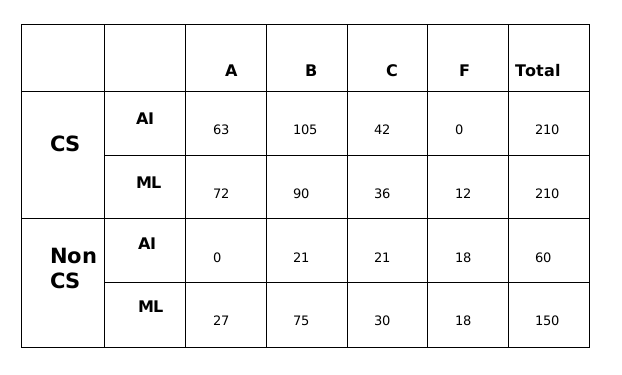
Substituting the values of a, b and x in the above table.
A total of 270 students took AI out of which 252 students passed and a total of 360 students took ML out of which 330 students passed.
From statement 4, we can say that out of the 252 students who passed in AI, 126 of them got Grade B and 63 got Grade A and 63 got Grade C.
Similarly, We can say that out of the 330 students who passed in ML, 165 of them got Grade C and 99 got Grade A and 66 got Grade C.
Therefore, the final table which we get is
Question 2
How many CS students failed in ML?
Solution:
Let the number of students in non-CS be 7x so no.of students taking AI in non-CS is 2x and no. of students taking ML in non-CS is 5x
All the CS students have taken both the courses, we are given this in the first line of the set.
From statement 5, we can conclude that 0 students from CS failed in AI and 0 students from non-CS got grade A in AI.
From statement 6, let us say that the numbers of CS students who got A, B and C grades respectively in AI were in the ratio 3a, 5a and 2a, while in ML the ratio was 4b, 5b and 2b.
From statement 3 we can say that the number of non- CS students who failed in AI and ML are b in each category.
Now from statement 8, we can say that number of CS students who failed in MI is equal to 30-b.
From statement 7, we can say that, $\frac{2b}{30-b}=\frac{3}{1}$
or, 2b = 90-3b
or, b= 18
CS students take both the AI and ML courses, therefore 10a= 10b +30
or, a= b+3 = 21
From statement 2, we can say that 10a = 7x
or, x = 30
Substituting the values of a, b and x in the above table.
A total of 270 students took AI out of which 252 students passed and a total of 360 students took ML out of which 330 students passed.
From statement 4, we can say that out of the 252 students who passed in AI, 126 of them got Grade B and 63 got Grade A and 63 got Grade C.
Similarly, We can say that out of the 330 students who passed in ML, 165 of them got Grade C and 99 got Grade A and 66 got Grade C.
Therefore, the final table which we get is
Question 3
How many non-CS students got A grade in ML?
Solution:
Let the number of students in non-CS be 7x so no.of students taking AI in non-CS is 2x and no. of students taking ML in non-CS is 5x
All the CS students have taken both the courses, we are given this in the first line of the set.
From statement 5, we can conclude that 0 students from CS failed in AI and 0 students from non-CS got grade A in AI.
From statement 6, let us say that the numbers of CS students who got A, B and C grades respectively in AI were in the ratio 3a, 5a and 2a, while in ML the ratio was 4b, 5b and 2b.
From statement 3 we can say that the number of non- CS students who failed in AI and ML are b in each category.
Now from statement 8, we can say that number of CS students who failed in MI is equal to 30-b.
From statement 7, we can say that, $\frac{2b}{30-b}=\frac{3}{1}$
or, 2b = 90-3b
or, b= 18
CS students take both the AI and ML courses, therefore 10a= 10b +30
or, a= b+3 = 21
From statement 2, we can say that 10a = 7x
or, x = 30
Substituting the values of a, b and x in the above table.
A total of 270 students took AI out of which 252 students passed and a total of 360 students took ML out of which 330 students passed.
From statement 4, we can say that out of the 252 students who passed in AI, 126 of them got Grade B and 63 got Grade A and 63 got Grade C.
Similarly, We can say that out of the 330 students who passed in ML, 165 of them got Grade C and 99 got Grade A and 66 got Grade C.
Therefore, the final table which we get is
Question 4
How many students got A grade in AI?
99
42
84
63
Solution:
Let the number of students in non-CS be 7x so no.of students taking AI in non-CS is 2x and no. of students taking ML in non-CS is 5x
All the CS students have taken both the courses, we are given this in the first line of the set.
From statement 5, we can conclude that 0 students from CS failed in AI and 0 students from non-CS got grade A in AI.
From statement 6, let us say that the numbers of CS students who got A, B and C grades respectively in AI were in the ratio 3a, 5a and 2a, while in ML the ratio was 4b, 5b and 2b.
From statement 3 we can say that the number of non- CS students who failed in AI and ML are b in each category.
Now from statement 8, we can say that number of CS students who failed in MI is equal to 30-b.
From statement 7, we can say that, $\frac{2b}{30-b}=\frac{3}{1}$
or, 2b = 90-3b
or, b= 18
CS students take both the AI and ML courses, therefore 10a= 10b +30
or, a= b+3 = 21
From statement 2, we can say that 10a = 7x
or, x = 30
Substituting the values of a, b and x in the above table.
A total of 270 students took AI out of which 252 students passed and a total of 360 students took ML out of which 330 students passed.
From statement 4, we can say that out of the 252 students who passed in AI, 126 of them got Grade B and 63 got Grade A and 63 got Grade C.
Similarly, We can say that out of the 330 students who passed in ML, 165 of them got Grade C and 99 got Grade A and 66 got Grade C.
Therefore, the final table which we get is
Question 5
How many non-CS students got B grade in ML?
165
75
25
90
Solution:
Let the number of students in non-CS be 7x so no.of students taking AI in non-CS is 2x and no. of students taking ML in non-CS is 5x
All the CS students have taken both the courses, we are given this in the first line of the set.
From statement 5, we can conclude that 0 students from CS failed in AI and 0 students from non-CS got grade A in AI.
From statement 6, let us say that the numbers of CS students who got A, B and C grades respectively in AI were in the ratio 3a, 5a and 2a, while in ML the ratio was 4b, 5b and 2b.
From statement 3 we can say that the number of non- CS students who failed in AI and ML are b in each category.
Now from statement 8, we can say that number of CS students who failed in MI is equal to 30-b.
From statement 7, we can say that, $\frac{2b}{30-b}=\frac{3}{1}$
or, 2b = 90-3b
or, b= 18
CS students take both the AI and ML courses, therefore 10a= 10b +30
or, a= b+3 = 21
From statement 2, we can say that 10a = 7x
or, x = 30
Substituting the values of a, b and x in the above table.
A total of 270 students took AI out of which 252 students passed and a total of 360 students took ML out of which 330 students passed.
From statement 4, we can say that out of the 252 students who passed in AI, 126 of them got Grade B and 63 got Grade A and 63 got Grade C.
Similarly, We can say that out of the 330 students who passed in ML, 165 of them got Grade C and 99 got Grade A and 66 got Grade C.
Therefore, the final table which we get is