
CAT 2023Slot 2DILRQuestion & Solution
Data Set
There are nine boxes arranged in a 3×3 array as shown in Tables 1 and 2. Each box contains three sacks. Each sack has a certain number of coins, between 1 and 9, both inclusive.
The average number of coins per sack in the boxes are all distinct integers. The total number of coins in each row is the same. The total number of coins in each column is also the same.
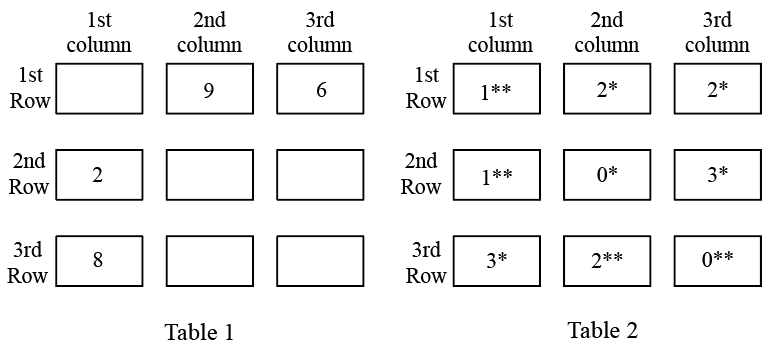
Table 1 gives information regarding the median of the numbers of coins in the three sacks in a box for some of the boxes. In Table 2 each box has a number which represents the number of sacks in that box having more than 5 coins. That number is followed by a * if the sacks in that box satisfy exactly one among the following three conditions, and it is followed by ** if two or more of these conditions are satisfied.
i) The minimum among the numbers of coins in the three sacks in the box is 1.
ii) The median of the numbers of coins in the three sacks is 1.
iii) The maximum among the numbers of coins in the three sacks in the box is 9.
Question 1
What is the total number of coins in all the boxes in the $3^{rd}$ row?
36
30
15
45
Solution:
We are given that each box contains three sacks. Each sack has a certain number of coins, between 1 and 9, both inclusive.
The average number of coins per sack in the boxes are all distinct integers. The total number of coins in each row is the same. The total number of coins in each column is also the same.
=> The total number of coins in a box range from 3 (1 + 1 + 1) to 27 (9 + 9 + 9)
Since, it is given that the average number of coins per sack in the boxes are all distinct integers => The total number of coins in a box would be 3, 6, 9, 12, 15, 18, 21, 24, 27 => averages of 1, 2, 3, 4,....,9 => Sum = 45.
=> Sum of averages coins in a box in a row or column = 45/3 = 15 [The total number of coins in each row is the same. The total number of coins in each column is also the same.] ==> (1)
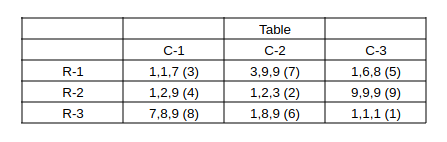
Let us represent the final configuration of the sacks in boxes as follows:
Also a bag (x,y) => bag in xth row and yth column.
We are given 2 clues => Table-1 & Table-2
Consider bag (3,1)
=> From Table-1 => Median = 8 & From Table-2 all 3 sacks have more than 5 coins. Also * => There is a 9 in one of the sacks.
=> c, 8, 9 are the coins in bag (3,1), now c > 5 & c + 8 + 9 should be a multiple of 3 => c = 7 is the only possiblility.
=> bag (3,1) has 7, 8, 9 coins with average = 8.
Consider bag (2,1)
Median = 2 and 1 sack has more than 5 coins. Also ** => conditions i & iii should be satisfied.
=> 1, 2, 9 are the coins in bag (2,1) with average = 4
Consider bag (1,2)
Median = 9 and 2 elements are more than 5. Also * => (9 is present & 1 is not present)
=> c, 9, 9 are the coins in bag (1,2) and c is not equal to 1 and less than 5 => c = 3 for c + 18 to be a multiple of 3.
=> 3, 9, 9 are the coins in bag (1,2) with average = 7.
Capturing this info. in the table:
From (1), The average in bag (1,1) is 15 - 4 - 8 = 3.
From (1), The average in bag (1,3) is 15 - 3 - 7 = 5.
Consider bag (1,1)
Avg = 3, 1 sack has more than 5 and ** => 2 conditions are being satisfied. => (can't be condition-3 => 9 coins as the total sum of coins is it self 3*3 = 9)
=> bag (1,1) has 1, 1, 7 coins with average = 3.
Consider bag (1,3)
Avg. = 5 => Sum = 15.
Median = 6 and 2 sacks have more than 5 and * => (1 condition is satisfied)
Not condition ii as the median is 6 & Not condition iii as the sum of 2 sacks itself will become 6 + 9 = 15
=> 1, 6, c are the coins => For sum = 15 => c = 15 - 1 - 6 = 8
=> bag (1,3) has 1, 6, 8 coins with average = 5.
Consider bag (3,3)
0 sacks have more than 5 coins and ** => conditions i & ii are being satisfied.
=> 1,1,c are the coins. Now c = 1 or 2 or 3 or 4 => c = 1 or 4 for number of coins to be a multiple of 3.
But c = 1 as no other bag has the possibility to get avg. = 1 as bag (2,2) should have 1, b, c coins and b and c should be more than 1 as only 1*
=> bag (3,3) has 1, 1, 1 coins with average = 1.
Now, we can fill the averages in all the bags.
In bag (2,3) Avg. = 9 => 9, 9, 9 are the coins.
In bag (2,2) => Avg. = 2 => Sum = 6 and only 1* => smallest elemens=t should be 1.
=> 1, b, c are the coins where b + c = 5 and b,c can't be equal to 1 and less than 5 => 2 + 3 = 5 is the only possibility.
=> 1, 2, 3 are the coins with average = 2.
Considering bag (3,2)
Avg. = 6 => Sum = 18.
2 sacks more than 5 coins and ** => 2 sacks have 1 and 9 coins.
=> bag (3,2) has 1, c, 9 coins and c = 18 - 1 - 9 = 8
=> bag (3,2) has 1, 8, 9 coins with average = 6 coins.
==> Final required table, bracket number => average coins per sack in the bag.
Sum of coins in 3rd row = 8*3 + 6*3 + 1*3 = 45.
Question 2
How many boxes have at least one sack containing 9 coins?
3
4
5
8
Solution:
We are given that each box contains three sacks. Each sack has a certain number of coins, between 1 and 9, both inclusive.
The average number of coins per sack in the boxes are all distinct integers. The total number of coins in each row is the same. The total number of coins in each column is also the same.
=> The total number of coins in a box range from 3 (1 + 1 + 1) to 27 (9 + 9 + 9)
Since, it is given that the average number of coins per sack in the boxes are all distinct integers => The total number of coins in a box would be 3, 6, 9, 12, 15, 18, 21, 24, 27 => averages of 1, 2, 3, 4,....,9 => Sum = 45.
=> Sum of averages coins in a box in a row or column = 45/3 = 15 [The total number of coins in each row is the same. The total number of coins in each column is also the same.] ==> (1)
Let us represent the final configuration of the sacks in boxes as follows:
Also a bag (x,y) => bag in xth row and yth column.
We are given 2 clues => Table-1 & Table-2
Consider bag (3,1)
=> From Table-1 => Median = 8 & From Table-2 all 3 sacks have more than 5 coins. Also * => There is a 9 in one of the sacks.
=> c, 8, 9 are the coins in bag (3,1), now c > 5 & c + 8 + 9 should be a multiple of 3 => c = 7 is the only possiblility.
=> bag (3,1) has 7, 8, 9 coins with average = 8.
Consider bag (2,1)
Median = 2 and 1 sack has more than 5 coins. Also ** => conditions i & iii should be satisfied.
=> 1, 2, 9 are the coins in bag (2,1) with average = 4
Consider bag (1,2)
Median = 9 and 2 elements are more than 5. Also * => (9 is present & 1 is not present)
=> c, 9, 9 are the coins in bag (1,2) and c is not equal to 1 and less than 5 => c = 3 for c + 18 to be a multiple of 3.
=> 3, 9, 9 are the coins in bag (1,2) with average = 7.
Capturing this info. in the table:
From (1), The average in bag (1,1) is 15 - 4 - 8 = 3.
From (1), The average in bag (1,3) is 15 - 3 - 7 = 5.
Consider bag (1,1)
Avg = 3, 1 sack has more than 5 and ** => 2 conditions are being satisfied. => (can't be condition-3 => 9 coins as the total sum of coins is it self 3*3 = 9)
=> bag (1,1) has 1, 1, 7 coins with average = 3.
Consider bag (1,3)
Avg. = 5 => Sum = 15.
Median = 6 and 2 sacks have more than 5 and * => (1 condition is satisfied)
Not condition ii as the median is 6 & Not condition iii as the sum of 2 sacks itself will become 6 + 9 = 15
=> 1, 6, c are the coins => For sum = 15 => c = 15 - 1 - 6 = 8
=> bag (1,3) has 1, 6, 8 coins with average = 5.
Consider bag (3,3)
0 sacks have more than 5 coins and ** => conditions i & ii are being satisfied.
=> 1,1,c are the coins. Now c = 1 or 2 or 3 or 4 => c = 1 or 4 for number of coins to be a multiple of 3.
But c = 1 as no other bag has the possibility to get avg. = 1 as bag (2,2) should have 1, b, c coins and b and c should be more than 1 as only 1*
=> bag (3,3) has 1, 1, 1 coins with average = 1.
Now, we can fill the averages in all the bags.
In bag (2,3) Avg. = 9 => 9, 9, 9 are the coins.
In bag (2,2) => Avg. = 2 => Sum = 6 and only 1* => smallest elemens=t should be 1.
=> 1, b, c are the coins where b + c = 5 and b,c can't be equal to 1 and less than 5 => 2 + 3 = 5 is the only possibility.
=> 1, 2, 3 are the coins with average = 2.
Considering bag (3,2)
Avg. = 6 => Sum = 18.
2 sacks more than 5 coins and ** => 2 sacks have 1 and 9 coins.
=> bag (3,2) has 1, c, 9 coins and c = 18 - 1 - 9 = 8
=> bag (3,2) has 1, 8, 9 coins with average = 6 coins.
==> Final required table, bracket number => average coins per sack in the bag.
Bags (2,1), (3,1), (1,2), (3,2), (2,3) have at least 1 sack with 9 coins. => Total of 5 bags.
Question 3
For how many boxes are the average and median of the numbers of coins contained in the three sacks in that box the same?
Solution:
We are given that each box contains three sacks. Each sack has a certain number of coins, between 1 and 9, both inclusive.
The average number of coins per sack in the boxes are all distinct integers. The total number of coins in each row is the same. The total number of coins in each column is also the same.
=> The total number of coins in a box range from 3 (1 + 1 + 1) to 27 (9 + 9 + 9)
Since, it is given that the average number of coins per sack in the boxes are all distinct integers => The total number of coins in a box would be 3, 6, 9, 12, 15, 18, 21, 24, 27 => averages of 1, 2, 3, 4,....,9 => Sum = 45.
=> Sum of averages coins in a box in a row or column = 45/3 = 15 [The total number of coins in each row is the same. The total number of coins in each column is also the same.] ==> (1)
Let us represent the final configuration of the sacks in boxes as follows:
Also a bag (x,y) => bag in xth row and yth column.
We are given 2 clues => Table-1 & Table-2
Consider bag (3,1)
=> From Table-1 => Median = 8 & From Table-2 all 3 sacks have more than 5 coins. Also * => There is a 9 in one of the sacks.
=> c, 8, 9 are the coins in bag (3,1), now c > 5 & c + 8 + 9 should be a multiple of 3 => c = 7 is the only possiblility.
=> bag (3,1) has 7, 8, 9 coins with average = 8.
Consider bag (2,1)
Median = 2 and 1 sack has more than 5 coins. Also ** => conditions i & iii should be satisfied.
=> 1, 2, 9 are the coins in bag (2,1) with average = 4
Consider bag (1,2)
Median = 9 and 2 elements are more than 5. Also * => (9 is present & 1 is not present)
=> c, 9, 9 are the coins in bag (1,2) and c is not equal to 1 and less than 5 => c = 3 for c + 18 to be a multiple of 3.
=> 3, 9, 9 are the coins in bag (1,2) with average = 7.
Capturing this info. in the table:
From (1), The average in bag (1,1) is 15 - 4 - 8 = 3.
From (1), The average in bag (1,3) is 15 - 3 - 7 = 5.
Consider bag (1,1)
Avg = 3, 1 sack has more than 5 and ** => 2 conditions are being satisfied. => (can't be condition-3 => 9 coins as the total sum of coins is it self 3*3 = 9)
=> bag (1,1) has 1, 1, 7 coins with average = 3.
Consider bag (1,3)
Avg. = 5 => Sum = 15.
Median = 6 and 2 sacks have more than 5 and * => (1 condition is satisfied)
Not condition ii as the median is 6 & Not condition iii as the sum of 2 sacks itself will become 6 + 9 = 15
=> 1, 6, c are the coins => For sum = 15 => c = 15 - 1 - 6 = 8
=> bag (1,3) has 1, 6, 8 coins with average = 5.
Consider bag (3,3)
0 sacks have more than 5 coins and ** => conditions i & ii are being satisfied.
=> 1,1,c are the coins. Now c = 1 or 2 or 3 or 4 => c = 1 or 4 for number of coins to be a multiple of 3.
But c = 1 as no other bag has the possibility to get avg. = 1 as bag (2,2) should have 1, b, c coins and b and c should be more than 1 as only 1*
=> bag (3,3) has 1, 1, 1 coins with average = 1.
Now, we can fill the averages in all the bags.
In bag (2,3) Avg. = 9 => 9, 9, 9 are the coins.
In bag (2,2) => Avg. = 2 => Sum = 6 and only 1* => smallest elemens=t should be 1.
=> 1, b, c are the coins where b + c = 5 and b,c can't be equal to 1 and less than 5 => 2 + 3 = 5 is the only possibility.
=> 1, 2, 3 are the coins with average = 2.
Considering bag (3,2)
Avg. = 6 => Sum = 18.
2 sacks more than 5 coins and ** => 2 sacks have 1 and 9 coins.
=> bag (3,2) has 1, c, 9 coins and c = 18 - 1 - 9 = 8
=> bag (3,2) has 1, 8, 9 coins with average = 6 coins.
==> Final required table, bracket number => average coins per sack in the bag.
Average = Median in boxes (3,1), (2,2), (2,3) and (3,3) => 4 boxes.
Question 4
How many sacks have exactly one coin?
Solution:
We are given that each box contains three sacks. Each sack has a certain number of coins, between 1 and 9, both inclusive.
The average number of coins per sack in the boxes are all distinct integers. The total number of coins in each row is the same. The total number of coins in each column is also the same.
=> The total number of coins in a box range from 3 (1 + 1 + 1) to 27 (9 + 9 + 9)
Since, it is given that the average number of coins per sack in the boxes are all distinct integers => The total number of coins in a box would be 3, 6, 9, 12, 15, 18, 21, 24, 27 => averages of 1, 2, 3, 4,....,9 => Sum = 45.
=> Sum of averages coins in a box in a row or column = 45/3 = 15 [The total number of coins in each row is the same. The total number of coins in each column is also the same.] ==> (1)
Let us represent the final configuration of the sacks in boxes as follows:
Also a bag (x,y) => bag in xth row and yth column.
We are given 2 clues => Table-1 & Table-2
Consider bag (3,1)
=> From Table-1 => Median = 8 & From Table-2 all 3 sacks have more than 5 coins. Also * => There is a 9 in one of the sacks.
=> c, 8, 9 are the coins in bag (3,1), now c > 5 & c + 8 + 9 should be a multiple of 3 => c = 7 is the only possiblility.
=> bag (3,1) has 7, 8, 9 coins with average = 8.
Consider bag (2,1)
Median = 2 and 1 sack has more than 5 coins. Also ** => conditions i & iii should be satisfied.
=> 1, 2, 9 are the coins in bag (2,1) with average = 4
Consider bag (1,2)
Median = 9 and 2 elements are more than 5. Also * => (9 is present & 1 is not present)
=> c, 9, 9 are the coins in bag (1,2) and c is not equal to 1 and less than 5 => c = 3 for c + 18 to be a multiple of 3.
=> 3, 9, 9 are the coins in bag (1,2) with average = 7.
Capturing this info. in the table:
From (1), The average in bag (1,1) is 15 - 4 - 8 = 3.
From (1), The average in bag (1,3) is 15 - 3 - 7 = 5.
Consider bag (1,1)
Avg = 3, 1 sack has more than 5 and ** => 2 conditions are being satisfied. => (can't be condition-3 => 9 coins as the total sum of coins is it self 3*3 = 9)
=> bag (1,1) has 1, 1, 7 coins with average = 3.
Consider bag (1,3)
Avg. = 5 => Sum = 15.
Median = 6 and 2 sacks have more than 5 and * => (1 condition is satisfied)
Not condition ii as the median is 6 & Not condition iii as the sum of 2 sacks itself will become 6 + 9 = 15
=> 1, 6, c are the coins => For sum = 15 => c = 15 - 1 - 6 = 8
=> bag (1,3) has 1, 6, 8 coins with average = 5.
Consider bag (3,3)
0 sacks have more than 5 coins and ** => conditions i & ii are being satisfied.
=> 1,1,c are the coins. Now c = 1 or 2 or 3 or 4 => c = 1 or 4 for number of coins to be a multiple of 3.
But c = 1 as no other bag has the possibility to get avg. = 1 as bag (2,2) should have 1, b, c coins and b and c should be more than 1 as only 1*
=> bag (3,3) has 1, 1, 1 coins with average = 1.
Now, we can fill the averages in all the bags.
In bag (2,3) Avg. = 9 => 9, 9, 9 are the coins.
In bag (2,2) => Avg. = 2 => Sum = 6 and only 1* => smallest elemens=t should be 1.
=> 1, b, c are the coins where b + c = 5 and b,c can't be equal to 1 and less than 5 => 2 + 3 = 5 is the only possibility.
=> 1, 2, 3 are the coins with average = 2.
Considering bag (3,2)
Avg. = 6 => Sum = 18.
2 sacks more than 5 coins and ** => 2 sacks have 1 and 9 coins.
=> bag (3,2) has 1, c, 9 coins and c = 18 - 1 - 9 = 8
=> bag (3,2) has 1, 8, 9 coins with average = 6 coins.
==> Final required table, bracket number => average coins per sack in the bag.
Bag (1,1) => 2 sacks with 1 coins, (2,1) => 1 sack, (2,2) => 1 sack, (3,2) => 1 sack, (1,3) => 1 sack, (3,3) => 3 sacks.
=> Total = 2 + 1 + 1 + 1 + 1 + 3 = 9 sacks.
Question 5
In how many boxes do all three sacks contain different numbers of coins?
Solution:
We are given that each box contains three sacks. Each sack has a certain number of coins, between 1 and 9, both inclusive.
The average number of coins per sack in the boxes are all distinct integers. The total number of coins in each row is the same. The total number of coins in each column is also the same.
=> The total number of coins in a box range from 3 (1 + 1 + 1) to 27 (9 + 9 + 9)
Since, it is given that the average number of coins per sack in the boxes are all distinct integers => The total number of coins in a box would be 3, 6, 9, 12, 15, 18, 21, 24, 27 => averages of 1, 2, 3, 4,....,9 => Sum = 45.
=> Sum of averages coins in a box in a row or column = 45/3 = 15 [The total number of coins in each row is the same. The total number of coins in each column is also the same.] ==> (1)
Let us represent the final configuration of the sacks in boxes as follows:
Also a bag (x,y) => bag in xth row and yth column.
We are given 2 clues => Table-1 & Table-2
Consider bag (3,1)
=> From Table-1 => Median = 8 & From Table-2 all 3 sacks have more than 5 coins. Also * => There is a 9 in one of the sacks.
=> c, 8, 9 are the coins in bag (3,1), now c > 5 & c + 8 + 9 should be a multiple of 3 => c = 7 is the only possiblility.
=> bag (3,1) has 7, 8, 9 coins with average = 8.
Consider bag (2,1)
Median = 2 and 1 sack has more than 5 coins. Also ** => conditions i & iii should be satisfied.
=> 1, 2, 9 are the coins in bag (2,1) with average = 4
Consider bag (1,2)
Median = 9 and 2 elements are more than 5. Also * => (9 is present & 1 is not present)
=> c, 9, 9 are the coins in bag (1,2) and c is not equal to 1 and less than 5 => c = 3 for c + 18 to be a multiple of 3.
=> 3, 9, 9 are the coins in bag (1,2) with average = 7.
Capturing this info. in the table:
From (1), The average in bag (1,1) is 15 - 4 - 8 = 3.
From (1), The average in bag (1,3) is 15 - 3 - 7 = 5.
Consider bag (1,1)
Avg = 3, 1 sack has more than 5 and ** => 2 conditions are being satisfied. => (can't be condition-3 => 9 coins as the total sum of coins is it self 3*3 = 9)
=> bag (1,1) has 1, 1, 7 coins with average = 3.
Consider bag (1,3)
Avg. = 5 => Sum = 15.
Median = 6 and 2 sacks have more than 5 and * => (1 condition is satisfied)
Not condition ii as the median is 6 & Not condition iii as the sum of 2 sacks itself will become 6 + 9 = 15
=> 1, 6, c are the coins => For sum = 15 => c = 15 - 1 - 6 = 8
=> bag (1,3) has 1, 6, 8 coins with average = 5.
Consider bag (3,3)
0 sacks have more than 5 coins and ** => conditions i & ii are being satisfied.
=> 1,1,c are the coins. Now c = 1 or 2 or 3 or 4 => c = 1 or 4 for number of coins to be a multiple of 3.
But c = 1 as no other bag has the possibility to get avg. = 1 as bag (2,2) should have 1, b, c coins and b and c should be more than 1 as only 1*
=> bag (3,3) has 1, 1, 1 coins with average = 1.
Now, we can fill the averages in all the bags.
In bag (2,3) Avg. = 9 => 9, 9, 9 are the coins.
In bag (2,2) => Avg. = 2 => Sum = 6 and only 1* => smallest elemens=t should be 1.
=> 1, b, c are the coins where b + c = 5 and b,c can't be equal to 1 and less than 5 => 2 + 3 = 5 is the only possibility.
=> 1, 2, 3 are the coins with average = 2.
Considering bag (3,2)
Avg. = 6 => Sum = 18.
2 sacks more than 5 coins and ** => 2 sacks have 1 and 9 coins.
=> bag (3,2) has 1, c, 9 coins and c = 18 - 1 - 9 = 8
=> bag (3,2) has 1, 8, 9 coins with average = 6 coins.
==> Final required table, bracket number => average coins per sack in the bag.
Bags with different number of coins in all 3 sacks are (2,1), (3,2), (2,2), (3,2), (1,3) => 5 bags.