
CAT 2023Slot 3DILRQuestion & Solution
Data Set
Question 1
How many Split Inverter ACs did D2 sell?
Solution:
Let us assume, A is the total number of AC's sold
=> From the information that the total number of ACs sold in the city, 25% were of Window variant => Window AC's = A/4 and Split AC's = 3A/4
Now, let us assume B is the total number of inverter ACs
=> From the information that among the Inverter ACs sold, 20% were of Window variant.=> Window Inverter AC's = B/5 and Window Non-Inverter AC's = 4B/5
From - Condition-3
=> A/4 - B/5 = 6 and 4B/5 = 36 => B = 46 and A = 60.
Now, from condition-6
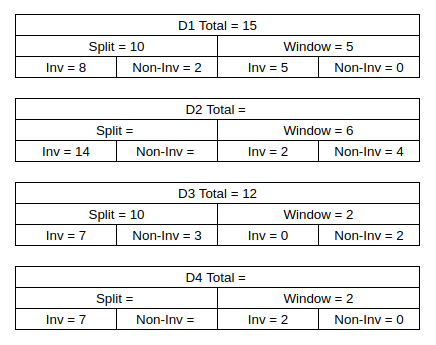
a) D1 & D4 sold "0" window Non-inverter ACs => D2 & D3 sold 6 window non-inverter ACs, it is given that D2 sold twice as many as D3 => D2 sold 4 and D3 sold 2 ACs of this type.
From condition-2
b) Let us assume, D1 sold "x" window inverter ACs => Number of split inverter ACs sold is 13-x
From condition-4
c) Number of split ACs sold by D1 will be "2x"
From condition-5
d) Let us assume 'y' is the number of window ACs sold by D3 & D4 => D2 sold 3y ACs of this type.
From condition-7
e) Let us assume 'z' is the number of split inverter ACs sold by D3 and D4 => D2 sold 2z ACs of this type.
Let us use a, b, c, d, and e make a table:
We know that the total number of window ACs is 15
=> x + 3y + y + y = 15 => x + 5y = 15, also x and y should be greater than or equal to 2 from condition-1
=> x = 5 and y = 2 is the only solution.
Filling this in the table:
Now, Number of split inverter ACs is 36
=> 8 + 2z + z + z = 36 => 4z = 28 => z = 7.
Filling this and using (5), the number of split AC's sold by D1 is 2*5 = 10.
From the table, we see that 14 split inverter ACs are sold.
Question 2
What percentage of ACs sold were of Non-inverter type?
33.33%
75.00%
25.00%
20.00%
Solution:
Let us assume, A is the total number of AC's sold
=> From the information that the total number of ACs sold in the city, 25% were of Window variant => Window AC's = A/4 and Split AC's = 3A/4
Now, let us assume B is the total number of inverter ACs
=> From the information that among the Inverter ACs sold, 20% were of Window variant.=> Window Inverter AC's = B/5 and Window Non-Inverter AC's = 4B/5
From - Condition-3
=> A/4 - B/5 = 6 and 4B/5 = 36 => B = 46 and A = 60.
Now, from condition-6
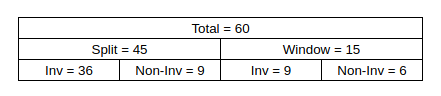
a) D1 & D4 sold "0" window Non-inverter ACs => D2 & D3 sold 6 window non-inverter ACs, it is given that D2 sold twice as many as D3 => D2 sold 4 and D3 sold 2 ACs of this type.
From condition-2
b) Let us assume, D1 sold "x" window inverter ACs => Number of split inverter ACs sold is 13-x
From condition-4
c) Number of split ACs sold by D1 will be "2x"
From condition-5
d) Let us assume 'y' is the number of window ACs sold by D3 & D4 => D2 sold 3y ACs of this type.
From condition-7
e) Let us assume 'z' is the number of split inverter ACs sold by D3 and D4 => D2 sold 2z ACs of this type.
Let us use a, b, c, d, and e make a table:
We know that the total number of window ACs is 15
=> x + 3y + y + y = 15 => x + 5y = 15, also x and y should be greater than or equal to 2 from condition-1
=> x = 5 and y = 2 is the only solution.
Filling this in the table:
Now, Number of split inverter ACs is 36
=> 8 + 2z + z + z = 36 => 4z = 28 => z = 7.
Filling this and using (5), the number of split AC's sold by D1 is 2*5 = 10.
From this table, we see that total number of non-inverter ACs is 9 + 6 = 15.
Required percentage is 15 out of 60 => 25%.
Question 3
What was the total number of ACs sold by D2 and D4?
Solution:
Let us assume, A is the total number of AC's sold
=> From the information that the total number of ACs sold in the city, 25% were of Window variant => Window AC's = A/4 and Split AC's = 3A/4
Now, let us assume B is the total number of inverter ACs
=> From the information that among the Inverter ACs sold, 20% were of Window variant.=> Window Inverter AC's = B/5 and Window Non-Inverter AC's = 4B/5
From - Condition-3
=> A/4 - B/5 = 6 and 4B/5 = 36 => B = 46 and A = 60.
Now, from condition-6
a) D1 & D4 sold "0" window Non-inverter ACs => D2 & D3 sold 6 window non-inverter ACs, it is given that D2 sold twice as many as D3 => D2 sold 4 and D3 sold 2 ACs of this type.
From condition-2
b) Let us assume, D1 sold "x" window inverter ACs => Number of split inverter ACs sold is 13-x
From condition-4
c) Number of split ACs sold by D1 will be "2x"
From condition-5
d) Let us assume 'y' is the number of window ACs sold by D3 & D4 => D2 sold 3y ACs of this type.
From condition-7
e) Let us assume 'z' is the number of split inverter ACs sold by D3 and D4 => D2 sold 2z ACs of this type.
Let us use a, b, c, d, and e make a table:
We know that the total number of window ACs is 15
=> x + 3y + y + y = 15 => x + 5y = 15, also x and y should be greater than or equal to 2 from condition-1
=> x = 5 and y = 2 is the only solution.
Filling this in the table:
Now, Number of split inverter ACs is 36
=> 8 + 2z + z + z = 36 => 4z = 28 => z = 7.
Filling this and using (5), the number of split AC's sold by D1 is 2*5 = 10.
Total number of ACs sold by D2 and D4 = 60 - D1 - D3 = 60 - 15 - 12 = 33.
Question 4
Which of the following statements is necessarily false?
D2 sold the highest number of ACs.
D4 sold more Split ACs as compared to D3.
D1 and D3 sold an equal number of Split ACs.
D1 and D3 together sold more ACs as compared to D2 and D4 together.
Solution:
Let us assume, A is the total number of AC's sold
=> From the information that the total number of ACs sold in the city, 25% were of Window variant => Window AC's = A/4 and Split AC's = 3A/4
Now, let us assume B is the total number of inverter ACs
=> From the information that among the Inverter ACs sold, 20% were of Window variant.=> Window Inverter AC's = B/5 and Window Non-Inverter AC's = 4B/5
From - Condition-3
=> A/4 - B/5 = 6 and 4B/5 = 36 => B = 46 and A = 60.
Now, from condition-6
a) D1 & D4 sold "0" window Non-inverter ACs => D2 & D3 sold 6 window non-inverter ACs, it is given that D2 sold twice as many as D3 => D2 sold 4 and D3 sold 2 ACs of this type.
From condition-2
b) Let us assume, D1 sold "x" window inverter ACs => Number of split inverter ACs sold is 13-x
From condition-4
c) Number of split ACs sold by D1 will be "2x"
From condition-5
d) Let us assume 'y' is the number of window ACs sold by D3 & D4 => D2 sold 3y ACs of this type.
From condition-7
e) Let us assume 'z' is the number of split inverter ACs sold by D3 and D4 => D2 sold 2z ACs of this type.
Let us use a, b, c, d, and e make a table:
We know that the total number of window ACs is 15
=> x + 3y + y + y = 15 => x + 5y = 15, also x and y should be greater than or equal to 2 from condition-1
=> x = 5 and y = 2 is the only solution.
Filling this in the table:
Now, Number of split inverter ACs is 36
=> 8 + 2z + z + z = 36 => 4z = 28 => z = 7.
Filling this and using (5), the number of split AC's sold by D1 is 2*5 = 10.
We see that D1 & D3 sold 27 ACs together which is less than 60 - 27 = 33 sold by D2 & D4.
=> Option-D is definitely false.
Question 5
If D3 and D4 sold an equal number of ACs, then what was the number of Non-inverter ACs sold by D2?
4
5
7
6
Solution:
Let us assume, A is the total number of AC's sold
=> From the information that the total number of ACs sold in the city, 25% were of Window variant => Window AC's = A/4 and Split AC's = 3A/4
Now, let us assume B is the total number of inverter ACs
=> From the information that among the Inverter ACs sold, 20% were of Window variant.=> Window Inverter AC's = B/5 and Window Non-Inverter AC's = 4B/5
From - Condition-3
=> A/4 - B/5 = 6 and 4B/5 = 36 => B = 46 and A = 60.
Now, from condition-6
a) D1 & D4 sold "0" window Non-inverter ACs => D2 & D3 sold 6 window non-inverter ACs, it is given that D2 sold twice as many as D3 => D2 sold 4 and D3 sold 2 ACs of this type.
From condition-2
b) Let us assume, D1 sold "x" window inverter ACs => Number of split inverter ACs sold is 13-x
From condition-4
c) Number of split ACs sold by D1 will be "2x"
From condition-5
d) Let us assume 'y' is the number of window ACs sold by D3 & D4 => D2 sold 3y ACs of this type.
From condition-7
e) Let us assume 'z' is the number of split inverter ACs sold by D3 and D4 => D2 sold 2z ACs of this type.
Let us use a, b, c, d, and e make a table:
We know that the total number of window ACs is 15
=> x + 3y + y + y = 15 => x + 5y = 15, also x and y should be greater than or equal to 2 from condition-1
=> x = 5 and y = 2 is the only solution.
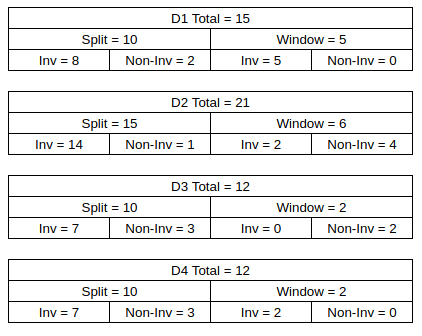
Filling this in the table:
Now, Number of split inverter ACs is 36
=> 8 + 2z + z + z = 36 => 4z = 28 => z = 7.
Filling this and using (5), the number of split AC's sold by D1 is 2*5 = 10.
If D3 and D4 sold equal number of AC's, the table will look as follows:
Number of non-inverter ACs sold is 1 + 4 = 5