
CAT 2024Slot 2DILRQuestion & Solution
Data Set
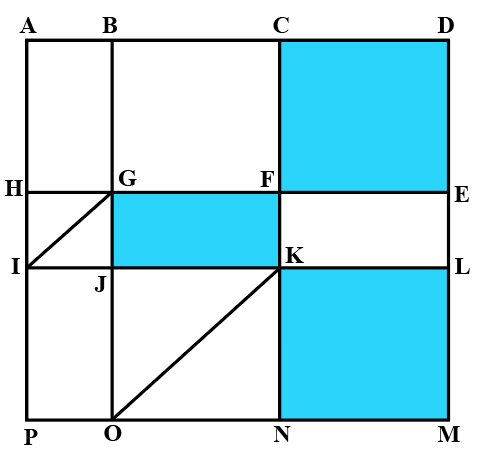
The above is a schematic diagram of walkways (indicated by all the straight-lines) and lakes (3 of them, each in the shape of rectangles - shaded in the diagram) of a gated area. Different points on the walkway are indicated by letters (A through P) with distances being OP = 150 m, ON = MN = 300 m, ML = 400 m, EL = 200 m, DE = 400 m.
The following additional information about the facilities in the area is known.
1. The only entry/exit point is at C.
2. There are many residences within the gated area; all of them are located on the path AH and ML with four of them being at A, H, M, and L.
3. The post office is located at P and the bank is located at B.
Question 1
One resident whose house is located at L, needs to visit the post office as well as the bank. What is the minimum distance (in m) he has to walk starting from his residence and returning to his residence after visiting both the post office and the bank?
2700
3200
3000
3400
Solution:
The first thing to realise here is the lengths of the paths.
KN should be equal to LM, giving the length of KO using Pythagoras theorem as 500m
Similarly, the length of HJ=OP=150m and length of GJ=EL=200m, giving the length of HG as 250 m
The shortest path from L to B and then to P (or the other way around would involve) using these hypotenuses as much as possible instead of the two adjacent sides. The shortest can be visualised as shown below or multitude of others variations, as there are multiple ways that would make one travel the shortest distance)
The below figure is the simplest one for visualisation.
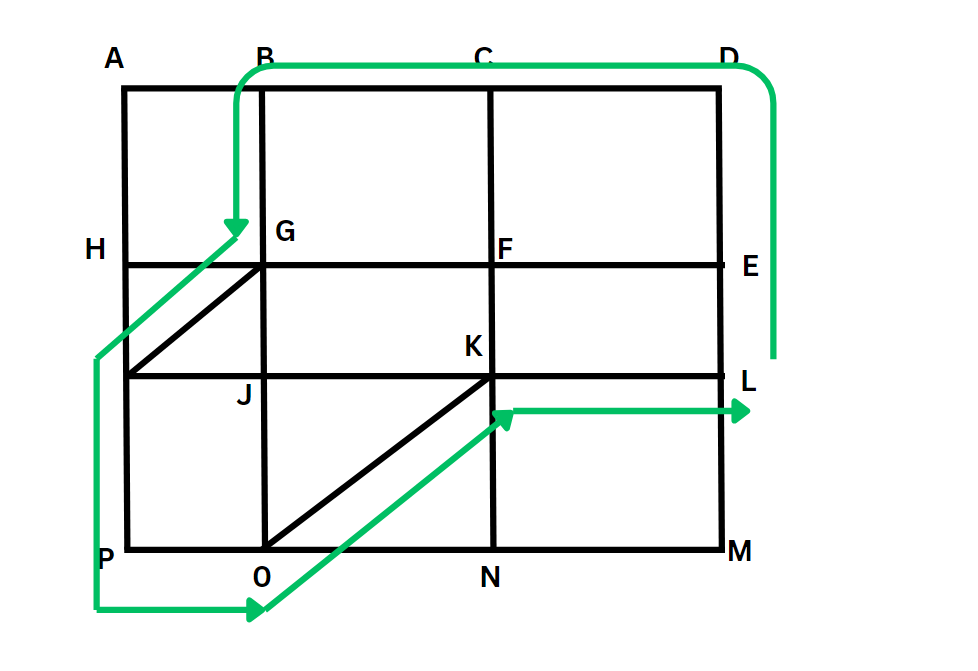
Other possible paths are L-E-F-C-.. and following the same path.
The shortest distance in each of these instance would be LE+ED+DC+CB+BG+GI+IP+PO+OK+KL
Which would be 200+400+300+300+400+250+400+150+500+300 = 3200
Therefore, Option B is the correct answer.
Question 2
One person enters the gated area and decides to walk as much as possible before leaving the area without walking along any path more than once and always walking next to one of the lakes. Note that he may cross a point multiple times. How much distance (in m) will he walk within the gated area?
2800
3000
3800
3200
Solution:
Since we can only walk along the side of lakes, that drastically reduces the paths we can take.
The diagram below shows the path with the maximum distance travelled.
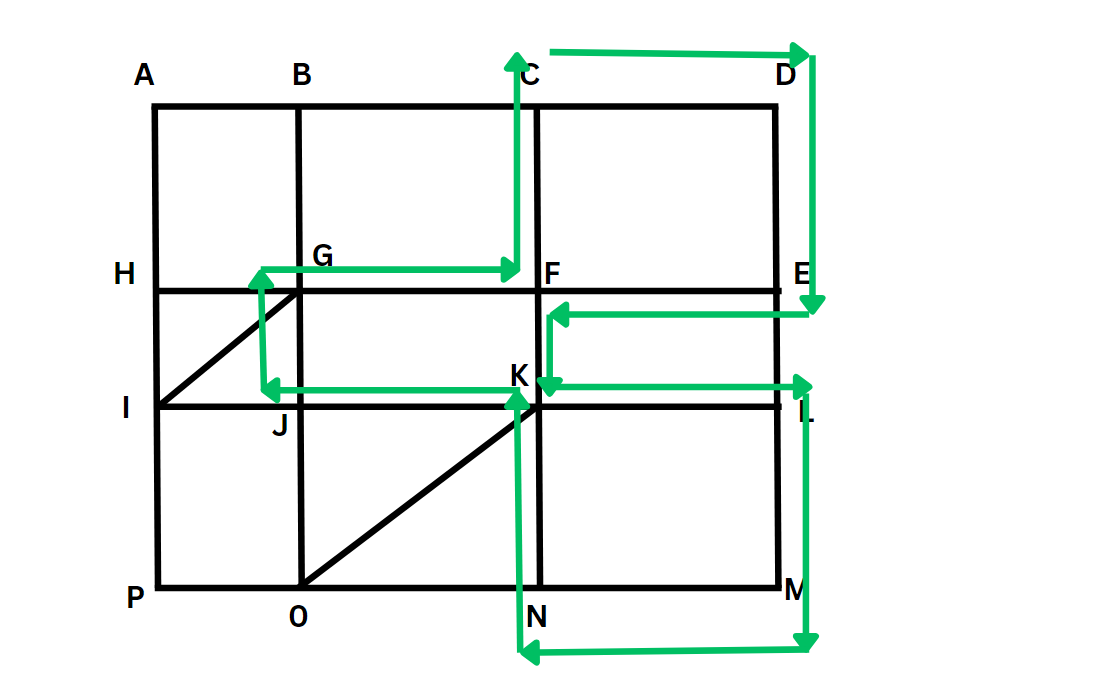
The path is CD-DE-EF-FK-KL-LM-MN-NK-KJ-JG-GF-FC
(the reverse of this path is also valid)
We can either manually add the lengths or use shorter methods to note that in the path we travel walkways of length 400 m 4 times (DE, LM, KN, EF), walkways of length 300m 6 times (CD, EF, KL, MN, KJ, GF) and walkways of length 200 m 2 times (FK, JG)
Giving the total length to be 1600+1800+400 = 3800
Therefore, Option C is the correct answer.
Question 3
One resident takes a walk within the gated area starting from A and returning to A without going through any point (other than A) more than once. What is the maximum distance (in m) she can walk in this way?
Solution:
Counter to the first question, we should minimize the use of those hypotenuse walkways as they reduce the distance we travel.
The longest possible route would include then travelling through the edges of the rectangles and sqaures, and not touch any point more than once.
Best case scenario would be us touching each point exactly once.
This can be visualized as:
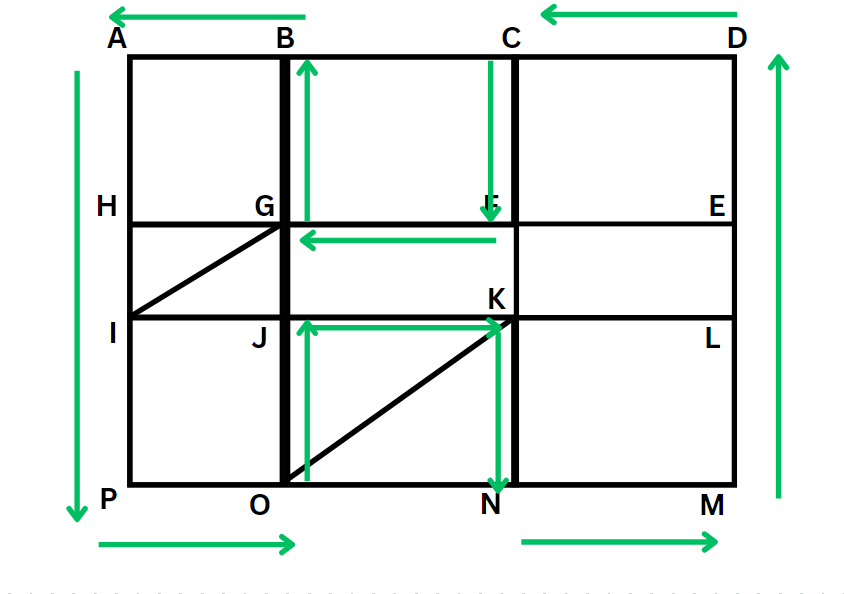
Where we do not use any of the hypotenuse and cross through each gate exactly once.
The total distance would be:
AH+HI+ IP = 400+200+400 = 1000
DE+EL+LM = 400+200+400 = 1000
PO+JK+NM = 150+300+300 = 750
DC+FG+BA = 150+300+300 = 750
JO+KN = 400+400 = 800
CF+GB = 400+400 = 800
Adding up to: 5100m
Therefore, 5100 is the correct answer.
Question 4
Visitors coming for morning walks are allowed to enter as long as they do not pass by any of the residences and do not cross any point (except C) more than once. What is the maximum distance (in m) that such a visitor can walk within the gated area?
Solution:
Similar to the previous question, we should try to avoid the hypotenuse
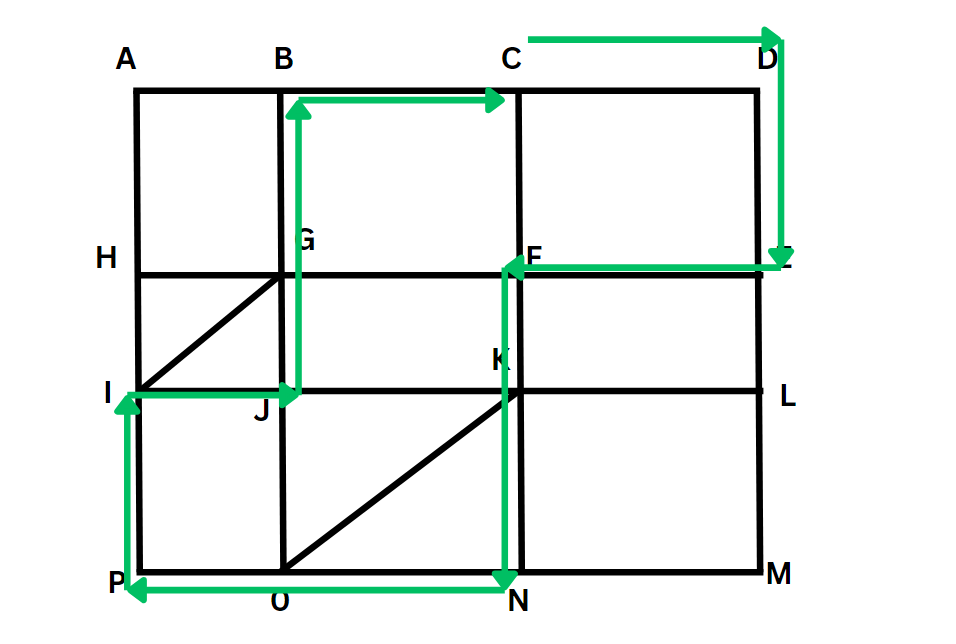
The total path distance would be 300(CD) + 400(DE) + 300(EF) + 200(FK) + 400(KN) + 300(NO) + 150(OP) + 400(PI) + 150(IJ) + 200(JG) + 400(GB) + 300(BC)
Adding up to 3,500 meters
Therefore, 3500 is the correct answer.