
CAT 2024Slot 3DILRQuestion & Solution
Data Set
The air-conditioner (AC) in a large room can be operated either in REGULAR mode or in POWER mode to reduce the temperature.
If the AC operates in REGULAR mode, then it brings down the temperature inside the room(called inside temperature) at a constant rate to the set temperature in 1 hour. If it operates in POWER mode, then this is achieved in 30 minutes.
If the AC is switched off, then the inside temperature rises at a constant rate so as to reach the temperature outside at the time of switching off in 1 hour.
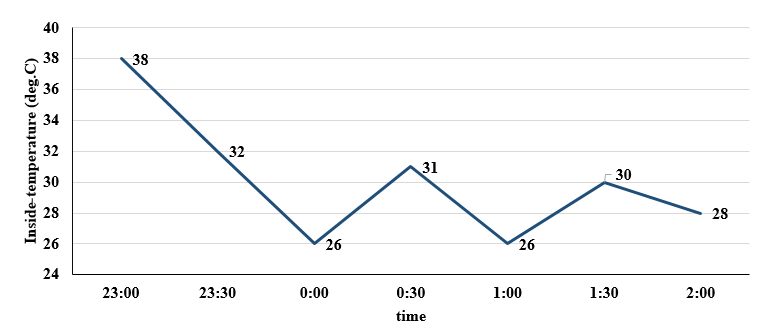
The temperature outside has been falling at a constant rate from 7 pm onward until 3 am on a particular night. The following graph shows the inside temperature between 11 pm (23:00)and 2 am (2:00) that night.
The following facts are known about the AC operation that night.
• The AC was turned on for the first time that night at 11 pm (23:00).
• The AC setting was changed (including turning it on/off, and/or setting different temperatures) only at the beginning of the hour or at 30 minutes after the hour.
• The AC was used in POWER mode for longer duration than in REGULAR mode during this 3-hour period.
Question 1
How many times the AC must have been turned off between 11:01 pm and 1:59 am?
cannot be determined
2
0
1
Solution:
The set's starting point is the conclusion that the temperature rises only when the AC is turned off.
When the AC is turned off, the temperature rises linearly, reaching the temperature at the time it was turned off in one hour.
The temperature rises in two instances,
From 0:00 to 0:30, it rises from 26 to 31, so by 1:00, it would have reached 36 degrees, meaning that the temperature at 0:00 would have been 36 degrees Celsius.
From 1:00 to 1:30, it rises from 26 to 30, so by 2:00, it would have reached 34 degrees, meaning the temperature at 1:00 would have been 34 degrees Celcius.
Calculating either of these would have been enough as we have the starting temperature at 23:00 at 38 degree celsius. Since the temperature decreases linearly, we can find the temperature at every instance using another data point.
Drawing out the temperature outside, we get:
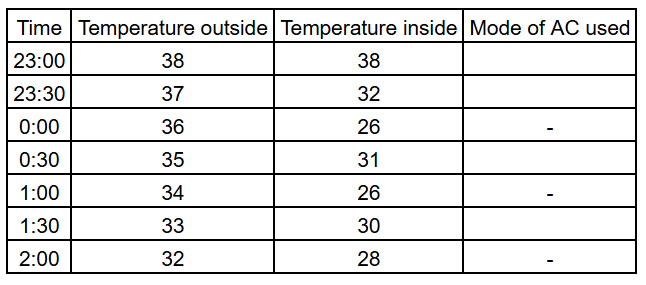
From this alone, we can answer the first question:
The AC was turned off for only two instances between 11:01 pm and 1:59 am:
Once at 0:00 and once at 1:00
Therefore, Option B is the correct answer.
Question 2
What was the temperature outside, in degree Celsius, at 1 am?
Solution:
The set's starting point is the conclusion that the temperature rises only when the AC is turned off.
When the AC is turned off, the temperature rises linearly, reaching the temperature at the time it was turned off in one hour.
The temperature rises in two instances,
From 0:00 to 0:30, it rises from 26 to 31, so by 1:00, it would have reached 36 degrees, meaning that the temperature at 0:00 would have been 36 degrees Celsius.
From 1:00 to 1:30, it rises from 26 to 30, so by 2:00, it would have reached 34 degrees, meaning the temperature at 1:00 would have been 34 degrees Celcius.
Calculating either of these would have been enough as we have the starting temperature at 23:00 at 38 degree celsius. Since the temperature decreases linearly, we can find the temperature at every instance using another data point.
Drawing out the temperature outside, we get:
From the table, we can determine that the temperature outside at 1 am was 34 degrees Celsius.
Therefore, 34 is the correct answer.
Question 3
What was the temperature outside, in degree Celsius, at 9 pm?
Solution:
The set's starting point is the conclusion that the temperature rises only when the AC is turned off.
When the AC is turned off, the temperature rises linearly, reaching the temperature at the time it was turned off in one hour.
The temperature rises in two instances,
From 0:00 to 0:30, it rises from 26 to 31, so by 1:00, it would have reached 36 degrees, meaning that the temperature at 0:00 would have been 36 degrees Celsius.
From 1:00 to 1:30, it rises from 26 to 30, so by 2:00, it would have reached 34 degrees, meaning the temperature at 1:00 would have been 34 degrees Celcius.
Calculating either of these would have been enough as we have the starting temperature at 23:00 at 38 degree celsius. Since the temperature decreases linearly, we can find the temperature at every instance using another data point.
Drawing out the temperature outside, we get:
Extrapolating this linear chain of temperature drop (2 degrees drop every hour), we can see that the temperature at 22:00 would be 40 degrees Celsius, and the temperature at 21:00 or 9 pm would be 42 degrees Celsius.
Therefore, 42 is the correct answer.
Question 4
What best can be concluded about the number of times the AC must have either been turned on or the AC temperature setting been altered between 11:01 pm and 1:59 am?
More than 3
Either 2 or 3
Exactly 2
Exactly 3
Solution:
The set's starting point is the conclusion that the temperature rises only when the AC is turned off.
When the AC is turned off, the temperature rises linearly, reaching the temperature at the time it was turned off in one hour.
The temperature rises in two instances,
From 0:00 to 0:30, it rises from 26 to 31, so by 1:00, it would have reached 36 degrees, meaning that the temperature at 0:00 would have been 36 degrees Celsius.
From 1:00 to 1:30, it rises from 26 to 30, so by 2:00, it would have reached 34 degrees, meaning the temperature at 1:00 would have been 34 degrees Celcius.
Calculating either of these would have been enough as we have the starting temperature at 23:00 at 38 degree celsius. Since the temperature decreases linearly, we can find the temperature at every instance using another data point.
Drawing out the temperature outside, we get:
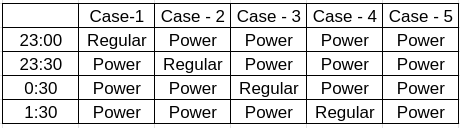
We can see that the AC was turned on at 0:30, 1:30 and 23:00.
We do not know about the status at 23:30
We are to count the times after 11:01 pm; hence, turning on the AC at 23:00 does not count.
Hence, the answer should be 2 or 3.
But in the final clue, we are given that POWER mode was used longer than REGULAR mode.
Since there are 4 periods of 30 minutes each, the combinations possible are POWER-3, REGULAR-1, and POWER-4, REGULAR-0
If the AC were on REGULAR mode at 23:00, it would have functioned for 1 hour, and the power mode would have also functioned for 1 hour (total), which would go against the final clue.
The following would be the cases.
But there were three instances of activation between 11:01 and 1:59
Hence, Option D would be the correct answer.
Question 5
What was the maximum difference between temperature outside and inside temperature, in degree Celsius, between 11:01 pm and 1:59 am?
Solution:
The set's starting point is the conclusion that the temperature rises only when the AC is turned off.
When the AC is turned off, the temperature rises linearly, reaching the temperature at the time it was turned off in one hour.
The temperature rises in two instances,
From 0:00 to 0:30, it rises from 26 to 31, so by 1:00, it would have reached 36 degrees, meaning that the temperature at 0:00 would have been 36 degrees Celsius.
From 1:00 to 1:30, it rises from 26 to 30, so by 2:00, it would have reached 34 degrees, meaning the temperature at 1:00 would have been 34 degrees Celcius.
Calculating either of these would have been enough as we have the starting temperature at 23:00 at 38 degree celsius. Since the temperature decreases linearly, we can find the temperature at every instance using another data point.
Drawing out the temperature outside, we get:
(Side note: We cannot consider the temperatures outside and inside at 23:00 and 2:00 since the time limit does not include those.)
The maximum difference between the elements of the outside and inside is maximum at 0:00 when the outside temperature is 36, and the inside temperature is 26.
Giving the maximum difference as 10
Therefore,10 is the correct answer.