
CAT 2025Slot 3DILRQuestion & Solution
Data Set
Anirbid, Chandranath, Koushik, and Suranjan participated in a puzzle solving competition. The competition comprised 10 puzzles that had to be solved in the same sequence, i.e., a competitor got access to a puzzle as soon as they solved the previous puzzle. Some of the puzzles were visual puzzles and the others were number-based puzzles. The winner of the competition was the one who solved all puzzles in the least time.
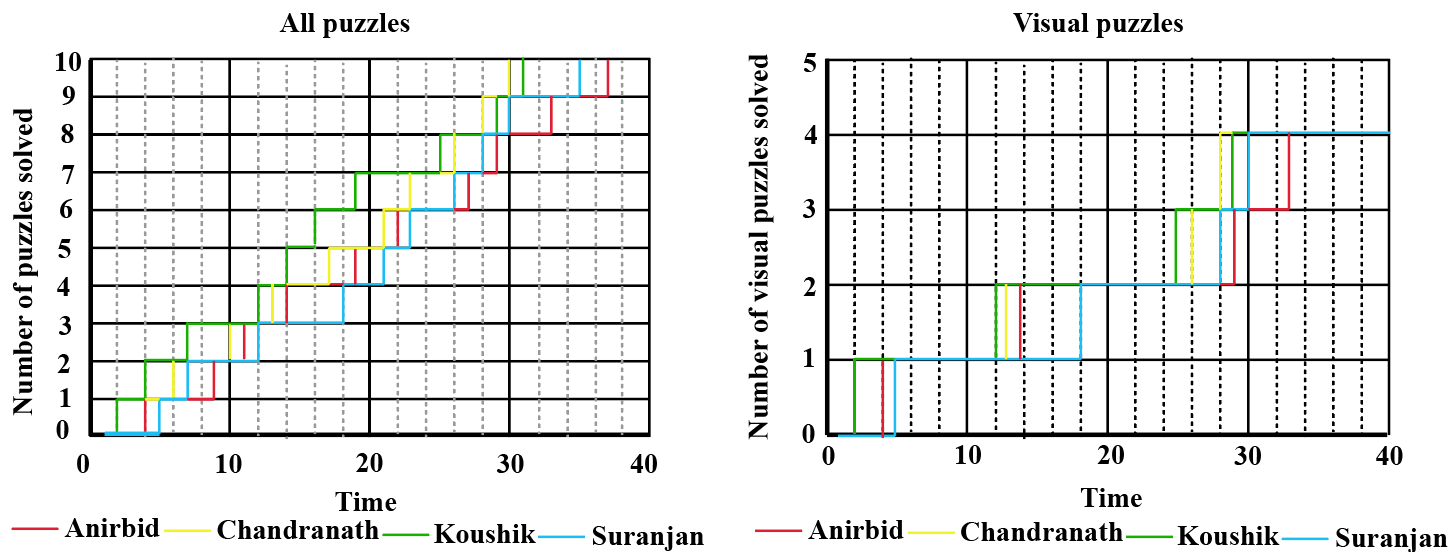
The following charts describe their progress in the competition. The chart on the left shows the number of puzzles solved by each competitor at a given time (in minutes) after the start of the competition. The chart on the right shows the number of visual puzzles solved by each competitor at a given time (in minutes) after the start of the competition.
Question 1
Who had solved the largest number of puzzles by the 20-th minute from the start of the competition?
Chandranath
Koushik
Suranjan
Anirbid
Solution:
The left plot shows, for each competitor, a step (staircase) curve whose height at any time t equals the number of puzzles that competitor has completed by minute t.
To find who solved the most puzzles by the 20th minute, draw a vertical line at t=20 (or simply read the height of each competitor’s colored stair at the vertical line x=20).
Reading the four curves at t=20:
The green staircase (Koushik) is at the highest horizontal level at t=20.
The yellow (Chandranath) and red (Anirbid) staircases are lower than the green ones at that time.
The blue (Suranjan) staircase is the lowest of the four at t=20.
Since Koushik’s value is greater than every other competitor’s at t=20, Koushik has solved the largest number of puzzles by the 20th minute.
Hence, the correct answer is option B.
Question 2
How many minutes did Suranjan take to solve the third visual puzzle in the competition?
Solution:
Comparing the 1st and 2nd graphs, we should be able to determine the type of puzzle.
From the second graph, we can say that there are 4 visual-based puzzles in total, which makes the number-based puzzles 6.
Let us follow the green line in both graphs:
The 1st visual-based puzzle was completed by Green in 2 minutes from the 2nd graph. From the 1st graph at the 2nd minute, the puzzle that was solved by Green was 1. So, we can say that 1 is a visual-based puzzle.
The 2nd visual-based puzzle was completed by Green in 12 minutes from the 2nd graph. From the 1st graph at the 12th minute, the puzzle that was solved by Green was 4. So, we can say that 4 is a visual-based puzzle.
The 3rd visual-based puzzle was completed by Green in 25 minutes from the 2nd graph. From the 1st graph at the 25th minute, the puzzle that was solved by Green was 8. So, we can say that 8 is a visual-based puzzle.
The 4th visual-based puzzle was completed by Green in 29 minutes from the 2nd graph. From the 1st graph at the 29th minute, the puzzle that was solved by Green was 9. So, we can say that 9 is a visual-based puzzle.
We can conclude that puzzles 1, 4, 8, and 9 are visual-based, while puzzles 2, 3, 5, 6, 7, and 10 are number-based.
So, the third visual puzzle is 8, and the time taken by Suranjan(blue) to complete the 3rd visual-based puzzle, which is the 8th puzzle, can be calculated as,
The time taken by Suranjan to solve the 8th puzzle from graph 1 = 28 - 26 = 2 minutes.
Hence, the correct answer is 2.
Question 3
At what number in the sequence was the fourth number-based puzzle?
Solution:
Comparing the 1st and 2nd graphs, we should be able to determine the type of puzzle.
From the second graph, we can say that there are 4 visual-based puzzles in total, which makes the number-based puzzles 6.
Let us follow the green line in both graphs:
The 1st visual-based puzzle was completed by Green in 2 minutes from the 2nd graph. From the 1st graph at the 2nd minute, the puzzle that was solved by Green was 1. So, we can say that 1 is a visual-based puzzle.
The 2nd visual-based puzzle was completed by Green in 12 minutes from the 2nd graph. From the 1st graph at the 12th minute, the puzzle that was solved by Green was 4. So, we can say that 4 is a visual-based puzzle.
The 3rd visual-based puzzle was completed by Green in 25 minutes from the 2nd graph. From the 1st graph at the 25th minute, the puzzle that was solved by Green was 8. So, we can say that 8 is a visual-based puzzle.
The 4th visual-based puzzle was completed by Green in 29 minutes from the 2nd graph. From the 1st graph at the 29th minute, the puzzle that was solved by Green was 9. So, we can say that 9 is a visual-based puzzle.
We can conclude that puzzles 1, 4, 8, and 9 are visual-based, while puzzles 2, 3, 5, 6, 7, and 10 are number-based.
The fourth number-based puzzle is 6th puzzle in the order.
Hence, the correct answer is 6.
Question 4
Which of the following is the closest to the average time taken by Anirbid to solve the number-based puzzles in the competition?
3.3 minutes
2.5 minutes
3.8 minutes
4.0 minutes
Solution:
Comparing the 1st and 2nd graphs, we should be able to determine the type of puzzle.
From the second graph, we can say that there are 4 visual-based puzzles in total, which makes the number-based puzzles 6.
Let us follow the green line in both graphs:
The 1st visual-based puzzle was completed by Green in 2 minutes from the 2nd graph. From the 1st graph at the 2nd minute, the puzzle that was solved by Green was 1. So, we can say that 1 is a visual-based puzzle.
The 2nd visual-based puzzle was completed by Green in 12 minutes from the 2nd graph. From the 1st graph at the 12th minute, the puzzle that was solved by Green was 4. So, we can say that 4 is a visual-based puzzle.
The 3rd visual-based puzzle was completed by Green in 25 minutes from the 2nd graph. From the 1st graph at the 25th minute, the puzzle that was solved by Green was 8. So, we can say that 8 is a visual-based puzzle.
The 4th visual-based puzzle was completed by Green in 29 minutes from the 2nd graph. From the 1st graph at the 29th minute, the puzzle that was solved by Green was 9. So, we can say that 9 is a visual-based puzzle.
We can conclude that puzzles 1, 4, 8, and 9 are visual-based, while puzzles 2, 3, 5, 6, 7, and 10 are number-based.
The average time taken by Anirbid to solve the number-based puzzles can be calculated as,
Time for 1st number-based puzzle(2nd puzzle) from 1st graph = 9 - 4 = 5 minutes.
Time for 2nd number-based puzzle(3rd puzzle) from 1st graph = 11 - 9 = 2 minutes.
Time for 3rd number-based puzzle(5th puzzle) from 1st graph = 19 - 14 = 5 minutes.
Time for 4th number-based puzzle(6th puzzle) from 1st graph = 22 - 19 = 3 minutes.
Time for 5th number-based puzzle(7th puzzle) from 1st graph = 27 - 22 = 5 minutes.
Time for 6th number-based puzzle(10th puzzle) from 1st graph = 37 - 33 = 4 minutes.
Average $$=\ \dfrac{5\ +\ 2\ +\ 5\ +\ 3\ +\ 5\ +\ 4}{6}\ =\ \dfrac{24}{6}\ =\ 4$$ minutes
The average time taken by Anirbid to solve the number-based puzzles is 4 minutes.
Hence, the correct answer is option D.